

I wrote this article at different dates, as noted in [brackets]1. The idea is for you to see my thoughts when I was in the thick of things, as well as how any issues eventually got resolved. The project is an arcade synth “for the end of the world,” but this writeup is about my process finishing a big project. The synth, one might say, is just an example. For actual project info, skip to here.
[June 22nd, 2026] Recently, I took on a rather large project for a client (SparkFun), which amounts to creating a custom synthesizer with their hardware, including the Teensy 4.1/Audio Shield. When I first proposed it, I thought it would be a cool build that would take me X hours to finish.2
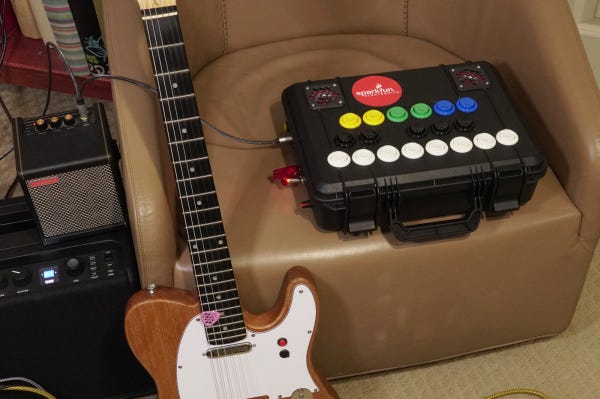
I think it will be an awesome build when finished [it is, keep reading]. However, like what seems like every build project that I accept (for myself or others), it’s taking me longer than I anticipated (at ~X+10 hours now). I have made a huge amount of progress on the build, but getting it working (and documented) is still going to take a non-negligible amount of extra effort.3
In other words, I’m at the point in this project where things start to become a bit of a slog. And I’m getting paid for the finished build/documentation, not an 80%-finished thing that sort of works. So I have to get it done. And I don’t always feel inspired to tackle the “heart” of the build (whatever that may be) even though I was so excited about it when it was first proposed.

If you’re into offbeat engineering, real-world builds, and practical tech thinking, subscribe 👇
But I’m not worried. I’ve been here many times in my engineering career, both working for myself and for others. The rather ridiculously obvious solution to such a challenge is:
Just keep working at it
Rather than procrastinating on this sort of big project — whether it’s a physical build; an intellectual product, e.g. a an article; or some combination, e.g. a build plus documentation — just work on the project in whatever manner that you currently feel like you can. This could mean running wires, taking pictures, cleaning up your BOM (bill of materials), drilling holes. Whatever. Just keep putting in the hours.
Put another way, get the little tasks done that may or may not seem like the crux of your project, and you’ll progress toward the metaphorical center as you nibble away at the edges. Work on the little things — which eventually add up to big things — and at some point, like magic, the project is done.
The above paragraph might seem rather obvious. However, when I brought this up to an engineering colleague of mine years ago he was in total agreement, noting that he’d discussed this phenomenon with another colleague who we both respected and worked with in multiple capacities.
How do you eat an elephant?
At another past employer, we were having machinery/production challenges, trying to increase yields and decrease rejected parts. It seemed like a rather impossible task on the whole, and at one point my boss asked me what seemed like a rather ridiculous question at the time: “How do you eat an elephant?” The correspondingly ridiculous answer: “one bite at a time.”
But this wasn’t actually a ridiculous question, or even a rather marginal dad joke. There’s a lot of truth in this mini-parable. We did, in fact, make some significant improvements over the time that I spent there, cutting the reject rate on what was arguably the factory’s most important machine in half. It took years, but we did eat that elephant, or at least a good portion of it, in bite-sized chunks.
Like magic, things became better — after years of consistent work.
Will I finish my current project?
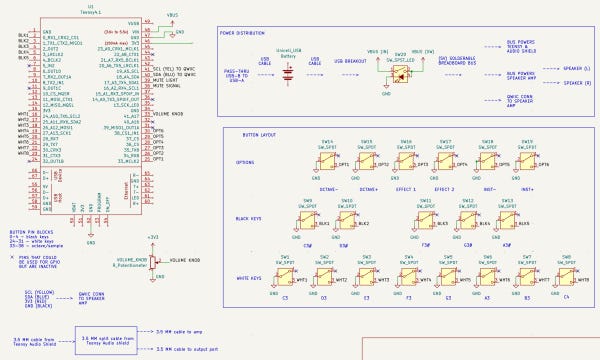
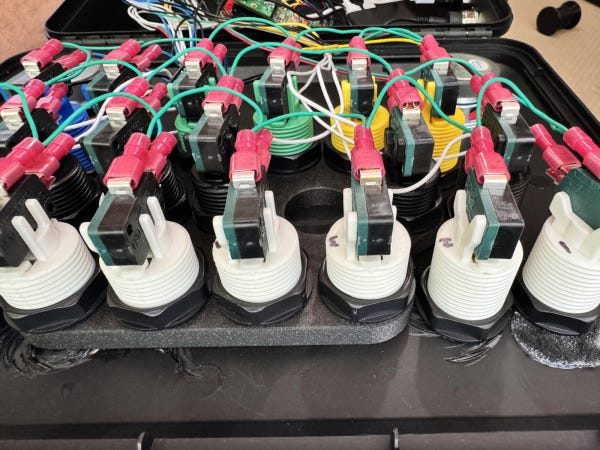
[July 3rd, 2026] After writing the above opening a week or two ago, I did keep chipping away at the project. And I now have a reasonably operational synth. It plays a full octave (including sharps/flats) with a keyboard-like arrangement of black and white arcade buttons. Six more buttons on the top of top of those are used for options and sound samples.
Two onboard speakers and a USB battery enable all-in-one portable operation, while a jack on the side allows it to interface with headphones or external equipment. At this point, I think it’s one of my coolest builds ever. A short clip is shown below, and the full build is at the end of this article:
While that might seem like the bulk of this project is done, consider that the other (really the core) requirement is to document it for the promotion of my client and so that someone else could build the same thing without too much trouble. A rough-cut video for them to produce and finalize was also one of the deliverables.
Documentation here is non-trivial, but with the synth operational, it’s (again) a matter of putting in the time and chipping away at the edges. Documentation should be accurate, but a missing semicolon doesn’t blow everything up in the same way that leaving it out of the Arduino C code that runs the synth would.
Project submitted!
[July 17th, 2026] After another ~two weeks of troubleshooting, programming, research, editing, and asking AI questions, I finally submitted my project yesterday for customer approval. I still want to do a few more things to/for the video before submitting it, but I should have that in next week.
As predicted, by chipping away at the edges, I eventually got to the center of a project, even though I have a bit more to do to consider it fully complete. Sometimes it doesn’t feel like you aren’t getting anywhere, but that’s just the process. Put in the time, and, like magic, it will get done.4
[August 26th, 2026] The project is fully complete, everything is submitted, and I was paid in full over a week ago. While the documentation was the product, they politely asked if I would be willing to send it over to use in their on-site electronics emporium for others to enjoy.
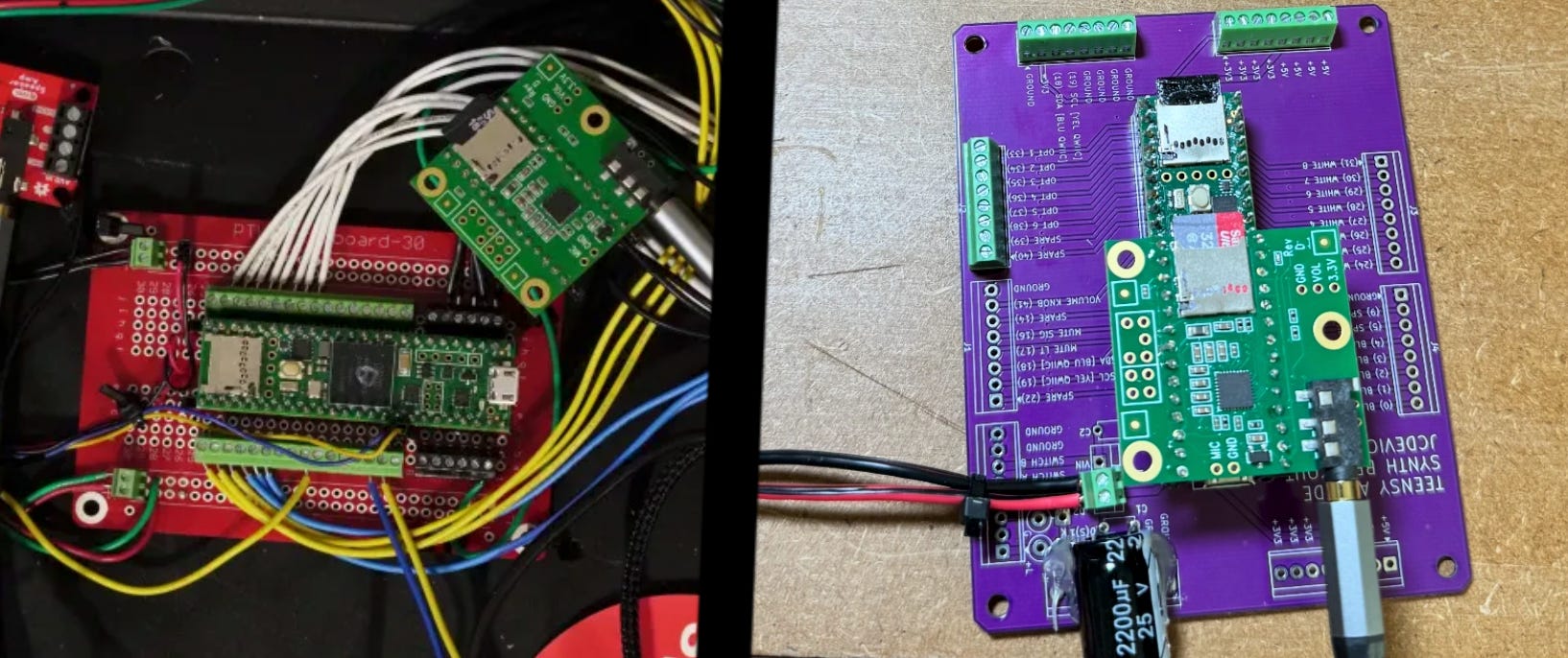
I agreed, and while it was sad to see it go, after completion these projects often collect dust anyway. Better to have others enjoy it [SparkFun later told me that Paul Stoffregen, creator of the Teensy boards got to try it out and really enjoyed it. How cool is that!]. SparkFun sent me replacement parts to make another synth version, and I actually came up with a breakout board to facilitate this future possibility. Perhaps a new, improved version is forthcoming. Subscribe so you don’t miss it👇 (You’ve read this far, might as well).
One of these breakouts is being used in a much different audiovisual project [the animatronic cowboy seen here], which takes advantage of some of the same Teensy hardware. That was yet another elephant, but being able to recycle knowledge and parts that you’re familiar with gives you a slightly bigger spoon.
Will I finish my other projects? Should I?
There are many, many projects that I have started over the years that I’ve yet to finish. And I don’t think that all of them will, or even should, be completed. There’s just not enough time in the day/year/my lifetime, and some many of them were pretty harebrained anyway.
And sometimes it’s best to just let a project go. Hopefully I’ve learned something in the process of half-making these ~failed/neglected/abandoned projects, but if you never finish anything (ever) then what have you really accomplished? Learning is good, but applying that learning to cool stuff that you get done is arguably the point — especially when you’re getting paid for it!
Sometimes I consider that maybe I need a “boss” to tell me that I need to finish project X, instead of starting Project Y and leaving that other build to a shelf somewhere. With the synth project that I’ve been discussing here, I did have an ad hoc boss in SparkFun. They presumably weren’t going to pay me if I never finished.
Such a boss might also tell me not to start other frivolous projects that I’m not getting paid for. Perhaps that’s the toughest part about working for yourself. You can only do so much. As my own boss, the prospect of starving, being thrown out on the street, or… gasp, getting a normal job is an excellent motivator.
The synth goes live!
[October 15th, 2026] As noted earlier, I submitted the writeup on July 16th, then a rough-cut video per my contract on July 24th, and invoiced on the same day. They paid me in a timely manner, but waited until today to release the video and writeup (I believe).
It’s awesome to see this go live (and to be able to put this post out). Hopefully it will inspire others to build something similar, and hopefully my new improved version… just might be forthcoming. Teensy breakout boards to make the wiring easier are for sale on SmallRun if you’re considering giving it a try! Maybe I’ll even sell finished synths in addition to the boards at some point.
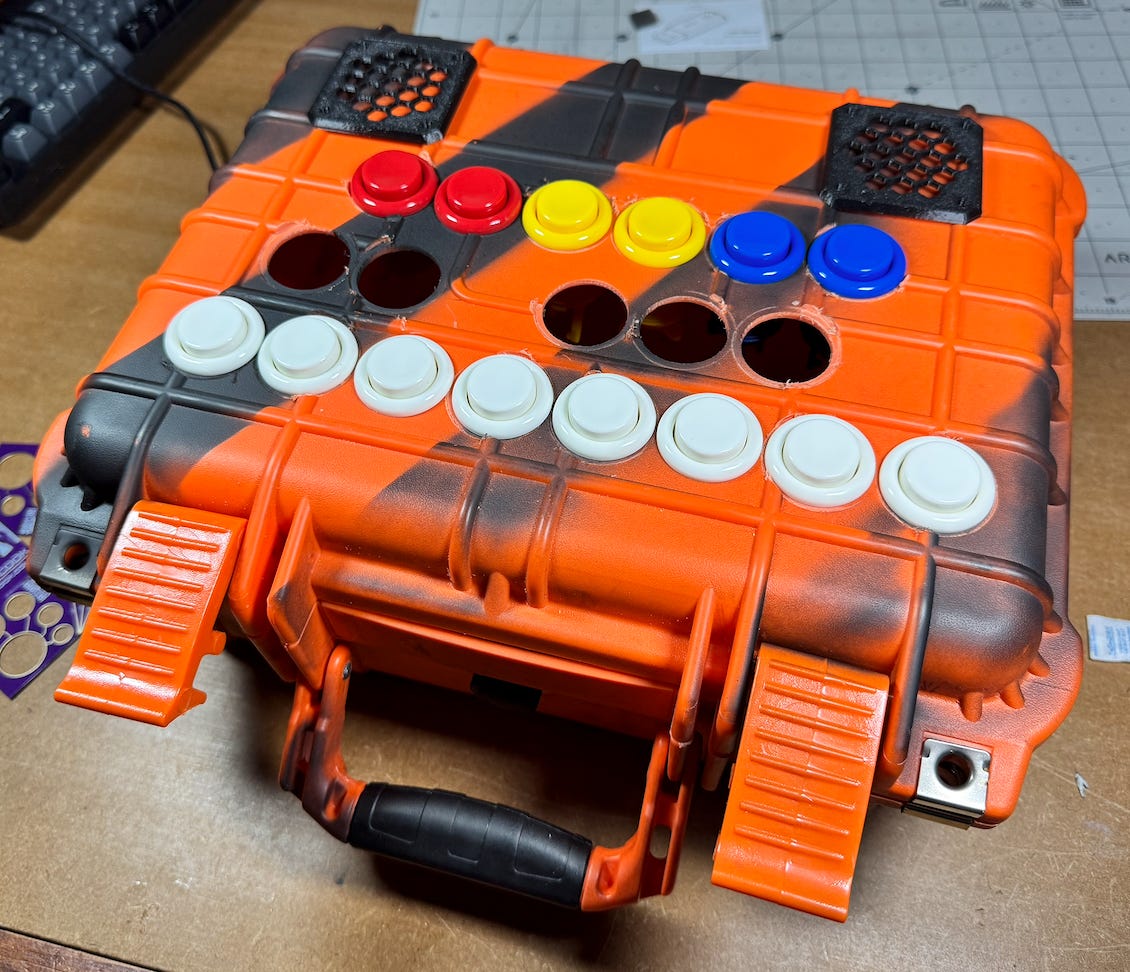
Finished synths wouldn’t cheap — I have bags of food to buy5 — but let me know if you might interested!
Thanks for reading! -JC
Techadjacent is where I share engineering ideas, builds, and practical tech analysis. Subscribe to get the next post in your inbox — published weekly👇
Thanks for reading! I hope you follow along on this Techadjacent journey. Fair warning: I can and do get a little off-topic in the footnotes. Get in touch: hi@jeremyscook.com, leave a comment, or just reply if you’re reading this as an email!
Note: Some links may be affiliate
Addendum/Footnotes:
There may be some edits/changes later. Largely this conveys things on certain dates, but this formatting may be a bit squirrely at times.
A number that I don’t remember now as I edit on October 15th, when they published the video, but apparently I did at some point.
Someone I worked with who previously owned a machine shop told me that you have to bid jobs in terms of “metric time.” Calculate this rate by taking whatever amount of time/expense you believe will take you and multiply by 2. Then add 15% to this number.
Or something like that. I think the point was that you have to take unexpected things into account by some sort of fudge factor. Figuring that factor out, or more accurately accounting for your time, would seem to be the difference between success and failure as a business.
OTOH, that person worked with me for the same larger company, and I really don’t know the whole story. Also, the calculation I listed was largely just made up by me in an attempt to convey his overall point. Take all that for what it’s worth.
There may be things that you want to change as you document. Add an extra wire here or there to correct a problem and all of a sudden your video and/or pictures are out of date. BUILD > TEST > then DOCUMENT is perhaps the ideal method here, but that procedure isn’t always practical if you take pictures as you go.
Negotiate Your Hourly Rate in Wendy's $5 Biggie Bags

At some point in the last few months, I went to Wendy’s with my son. With a family of five, dining out can get expensive, and I started to consider how much I get paid… in Wendy’s Biggie Bags. I’ll keep my specifics private, but do the math, and whether you get paid $15, $50, or $150/hour you may just be impressed with yourself!