

When the average person considers a robot, something like C-3P0 or R2-D2 may come to mind, moving about like a human or… a wheeled bucket(?) via some sort of vague electronic actuation. Of course, electronics alone isn’t the only way to control movement. Air power, AKA pneumatics, has long been a staple of industrial automation.
If you’re into offbeat engineering, real-world builds, and practical tech thinking, subscribe 👇
The killer application for pneumatics is that very fast and powerful linear actuators can be had in the low-two-figure range if you poke around online, or likely a bit more from well-known industrial suppliers. The big tradeoff is that you need an air compressor — something that isn’t exactly standard, but that many DIY types have, including myself. For experimentation per an upcoming class that I’m giving, I decided to spend the ~$50 required for a simple pneumatic actuator setup.1
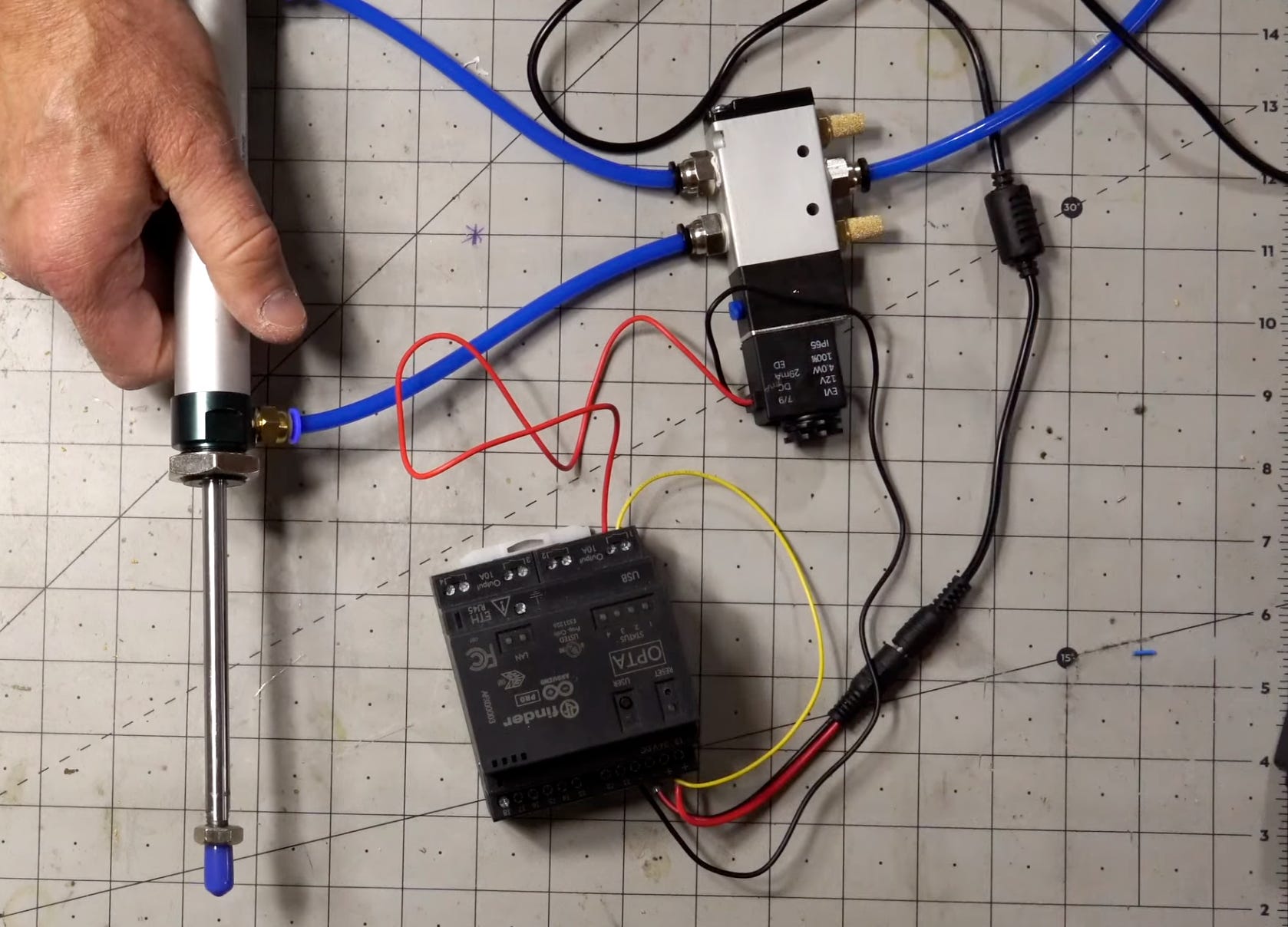
What do you need to pneumatically actuate?
As noted, most fundamentally you need an air compressor. I had one for a few years from Harbor freight that was ~$30 IIRC, which eventually broke. It was also extremely loud. The Makita compressor that I have now cost something like ~10x as much money, but is much quieter and… still works. I guess you get what you pay for.
Once that is sorted, my relatively simple pneumatics components bill of materials (BOM) is as follows:
With these parts in-hand, I connected the air lines as (mostly) shown in the image above, then hooked the solenoid valve’s wires up to an Arduino OPTA PLC’s built-in relay. The PLC was programmed with an extremely simple “relay blink” sketch. I.e. the relay simply cycles on or off every second.

As shown in the video below, the results are quite impressive, at a rather low cost. It can push with a force of the piston’s surface area x the applied air pressure. So here it would be 3.14 x 10mm^2 x 100 PSI. Doing the math/conversions yields 48.7 pounds on the outbound stroke.2 So about 50 pounds for $50. Not bad at all!
Of course, that doesn’t include the cost of the air compressor, which was already purchased, and has been extremely useful for so many reasons. I highly recommend this type of tool, even if you start with a cheapie.
While I think making a cylinder actuate is fun in and of itself, I do have a few pneumatics project ideas.
Why/what comes next?
If nothing else, this video and/or experimentation will be a nice bit for a class I’m going to give.3 It’s also a good demo of the Arduino OPTA, and perhaps something that will drive sales of my I2C/serial/MIDI breakout.
Perhaps the most obvious other idea I have for this tech is constructing a robotic drummer. While one might correctly say that this has been done before, I’ve yet to put my own spin on it. I think I could do a good job, though it would be hard to beat Kolja Kugler’s One Love Machine Band:
Of course, there are about a million things one can do with pneumatics, it always seems like my project list needs to contract, not expand. I’m not sure if that’s a good thing. Be sure to subscribe below for further updates… air-powered or not! -JC
Techadjacent is where I share engineering ideas, builds, and practical tech analysis. Subscribe to get the next post in your inbox — published weekly👇
Thanks for reading! I hope you follow along on this Techadjacent journey. Fair warning: I can and do get a little off-topic in the footnotes.
Note: Some links may be affiliate
Addendum/Footnotes:
Another big tradeoff of using pneumatics is that air power is often less efficient than the electronic equivalent. But good luck getting a solenoid to hit as hard as this sort of actuator at anywhere near the same price.
Also, compressors tend to be loud, or at least not silent. This may or may not be an issue, depending on the installation.
There is a bit less force on the inbound stroke, since you have to subtract out the surface area of the actual piston.
This will be part of the series: Intro to Physical Automation: Computing in the Real World. This particular class hasn’t actually been announced as of this writing, but you can sign up for the whole series there if you’re interested, and you should get informed when this one is imminent. I believe it will be class number four.
I’d love to have you there, and if you do show up please say hello in the in-class comments!