

Over the years, my soldering abilities have improved. While I still wouldn’t call myself excellent, I’m at not terrible. When the weather is right, I might even claim the title of fairly good. A huge part of this improvement is due to the fact that I have purchased — and made — better tools.
I’ll outline some of my purchased tools at the end, but this post is primarily about building a soldering jig (i.e. a solder squid) that suits my needs. I’ve yet to find one that you can buy that meets all of my requirements!

If you’re into offbeat engineering, real-world builds, and practical tech thinking, subscribe 👇
The solder squid
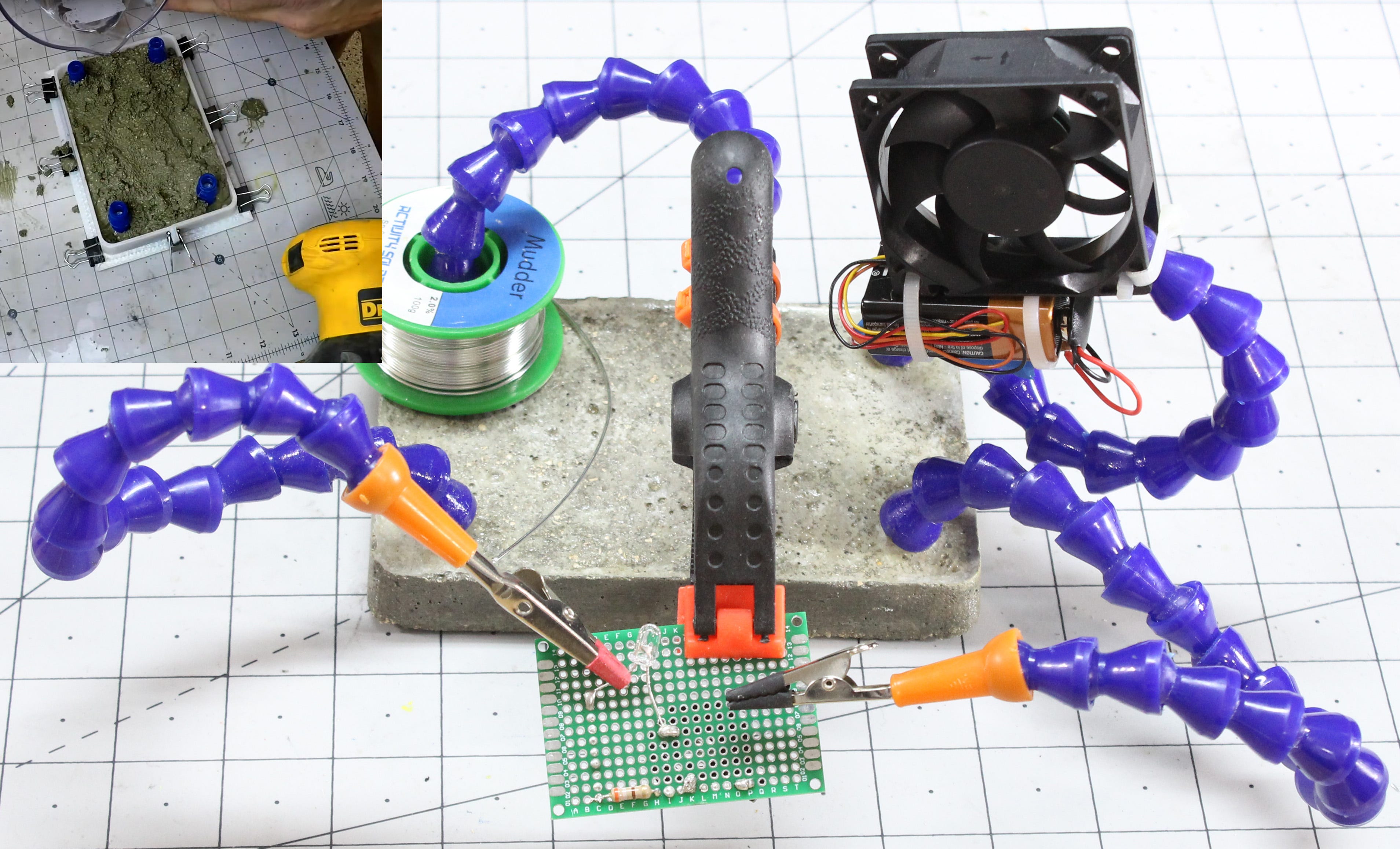
Soldering jigs/solder squids/helping hands typically feature a number of positionable arms with alligator clips on the end to hold wires and components in place while you solder them together. My criteria for such a device include:
Heavy
Electrically and thermally non-conductive base
Base won’t melt or burn when heat is applied
Built-in fume extractor
Bendable arms that stay in place
There are quite a few squidz available for purchase (this one, for example), but most appear rather light, with bases that may or may not live up to my thermal and electrical requirements. Built-in fume extractors seem to be non-existent, and who knows if the arms will stay solidly in place.
So I made my own. Or, more accurately, I developed one over years of experimentation.
Squid Element 1: Concrete base
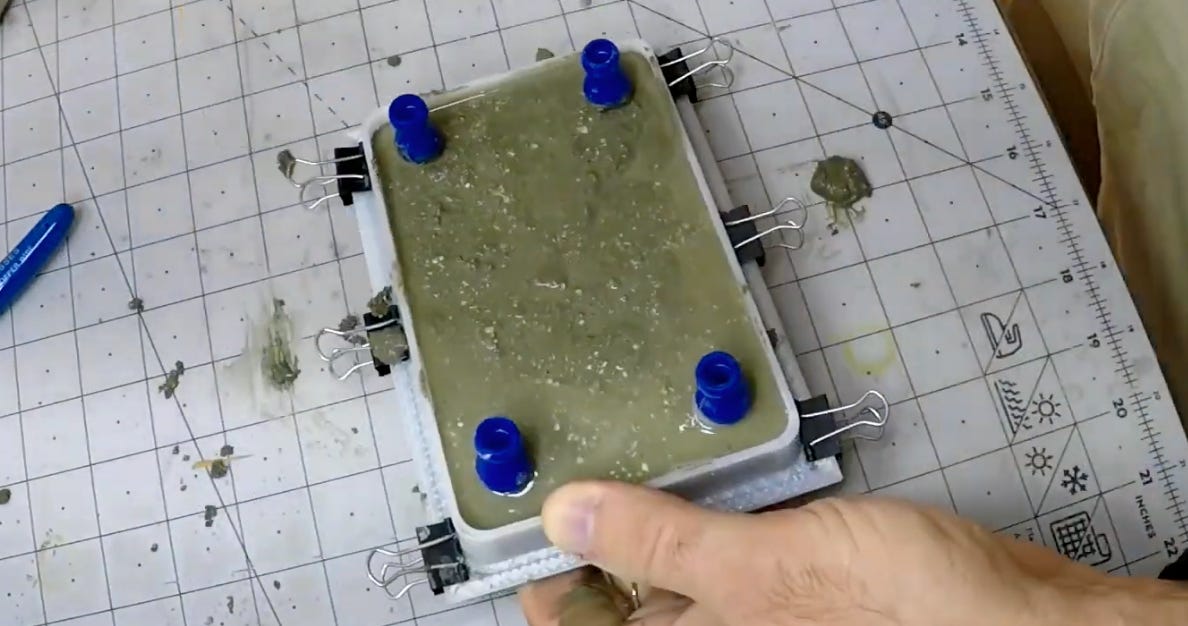
What’s strong, heavy, fireproof, non-conductive, and inexpensive? Concrete, of course! One can embed arms in the concrete as it is curing, solving the stay-in-place issue once and for all. I designed a 3D-printed mold for the base (available here) including bosses on which the base of the arms could sit as it cured.
In retrospect, I could probably have just about anything to make a block-o-concrete, though the bosses were a nice touch, leaving me with four perfectly space arms sticking out of the corners. I also coated it with concrete sealant, and added four rubber anti-slip nubs, both of which enhanced the design a bit.
Squid Element 2: Loc-Line arms, alligator clip grippers
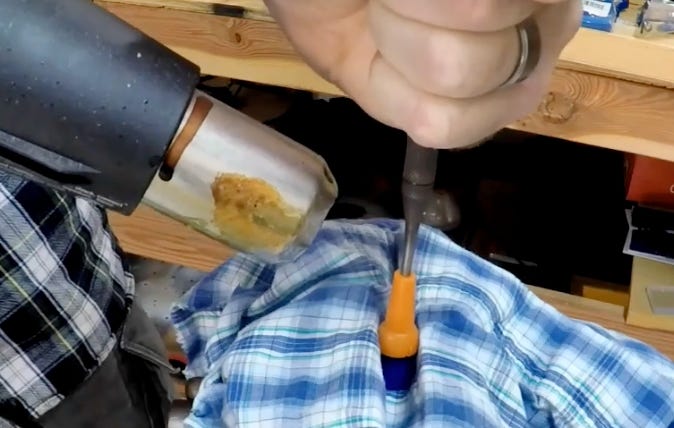
As shown above, I embedded the bottom of four Loc-Line hoses in the concrete, which has held up for several years now. To hold the alligator clips securely, I heated up each spout with a heat gun and expanded it with a metal marking tool and/or pick. With just enough space to slide the clips in when hot, when it cools off it forms a tight bond, which, as with the concrete, has held up for several years now.
I also added heat shrink to the jaws in order to prevent piercing softer things that are held in place by them.
Squid Element 3: Fume extractor (USB PC fan)
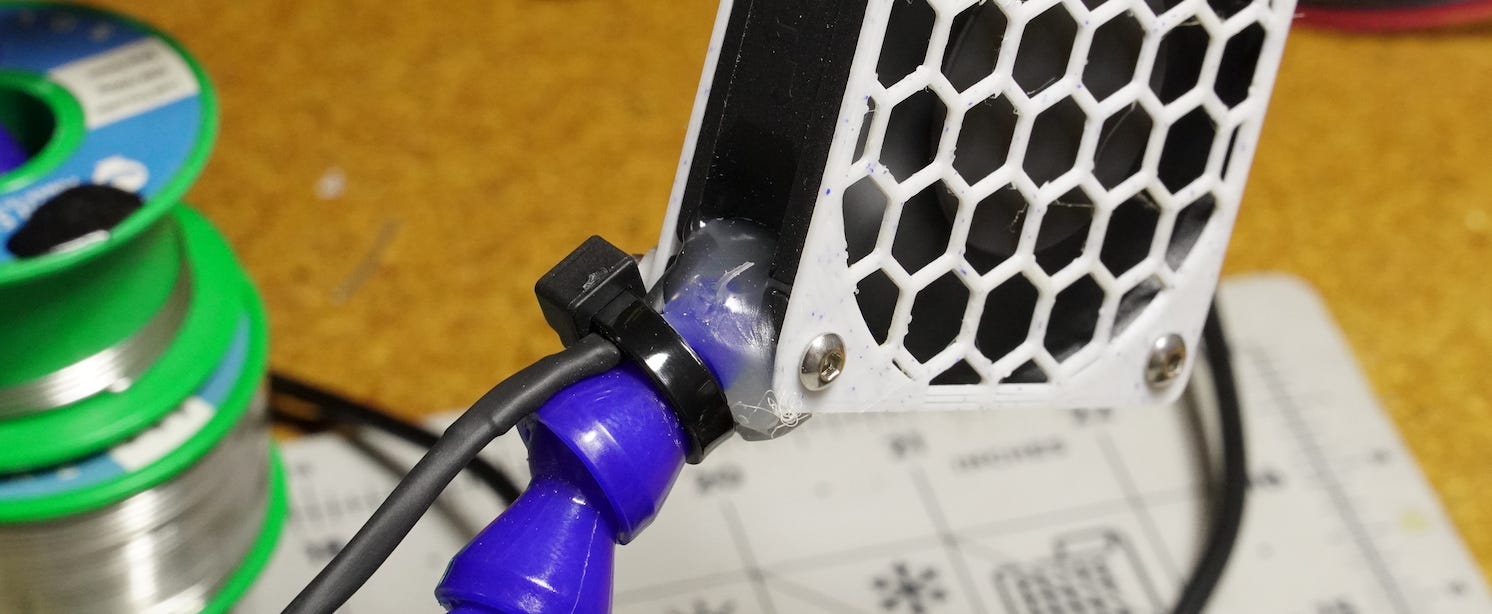
To make things easy, I used a 5V USB fan as a fume extractor. I zip-tied the cable, and hot glued the corner to one of the arms sans end piece/alligator clip. While I am generally happy with this setup, it could be more powerful, and there’s no on/off button at this point.
A simple latching switch would be easy enough to add. However, I had an idea to use one of my other gadgets to shut this off automatically after a certain amount of time. As so often happens, good here is the enemy of perfect.
Other soldering tools/component lessons
First, if I’m going to define a “good” soldering setup, what was I using when it was much worse? Basically, something like what’s shown below. (though not that item in particular). Plug it in and it heats up to… whatever temperature. For $6, that actually might be a good value, but prepare to be frustrated.
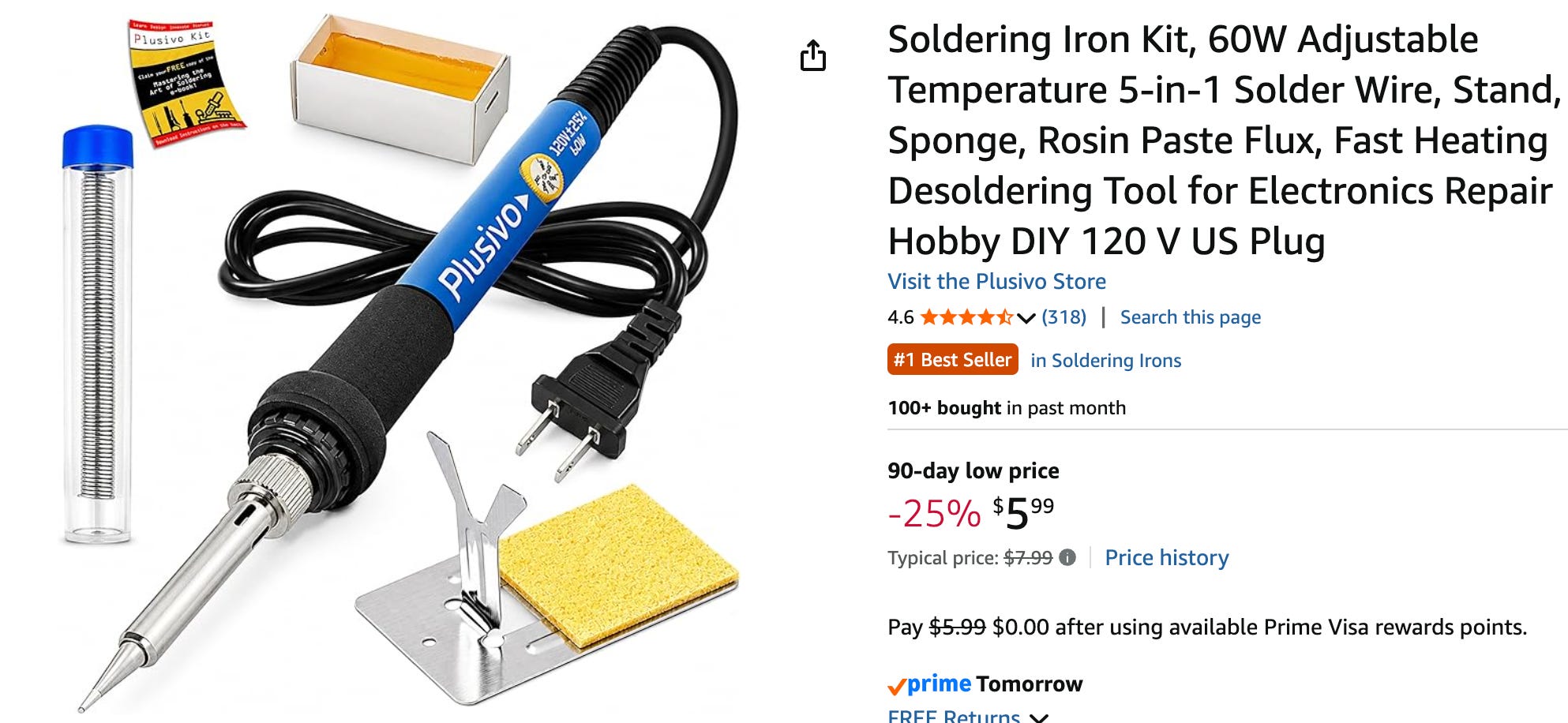
So, besides a custom squid, what soldering tools do I use to raise my game from poor to marginally good? I’m glad you asked, because I get a small % of purchases that you make on Amazon via these links:
TS100 mini soldering iron - I’ve been using this for nearly a decade, and it’s a HUGE improvement over the plug-in-and-wait ~$10 iron that I was using before. The link is for an upgraded TS101 iron, which I’d assume is as good or better.
Knipex wire clippers - Not cheap, but really a nice tool if you need to precisely snip a connection.
Tip cleaner, holder - I’m not going to link these, because what I purchased is either unavailable or way more expensive than what I have. But both of these are a good idea to obtain.
Hot air gun - not used for manual soldering so much, but when you need to heat up a board for desoldering or even to heat up heat shrink, this is a very convenient tool.
Hot plate - Like the hot air gun, sometimes you need to heat up a board. The link goes to another article I wrote reviewing different sizes, but the TL;DR: 100 x 100 mm seems to be not too big, not too small.
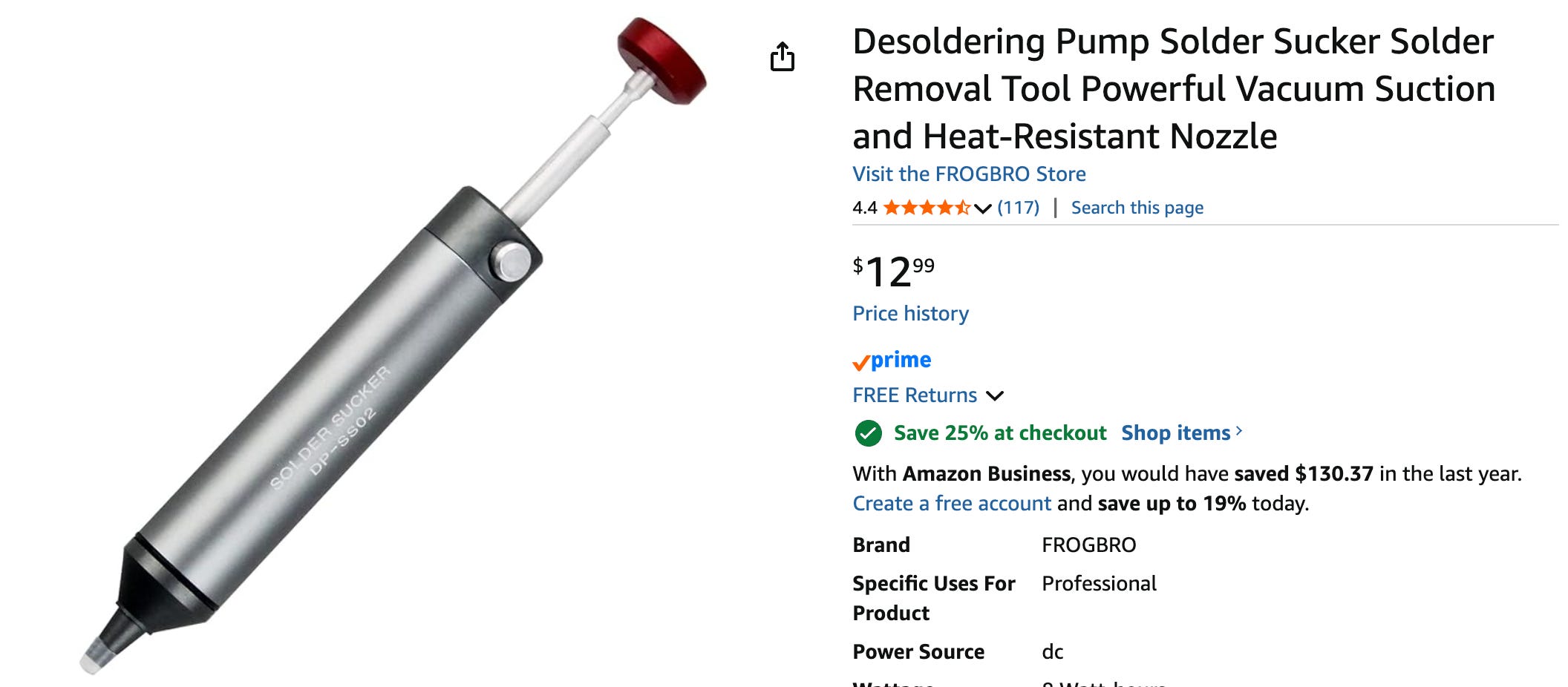
Solder sucker - for removal of solder, you need either solder wick or a solder suction device. Plastic blue suckers are available at very low prices, or in kits, but the aluminum type with silicon tips are much better. I got one from “Kotto” which is quite nice, but appears to not be available. This suction device by Engineer (a well-known brand) is likely also quite good. This “FrogBro” model could also be good, though I’m… less familiar with that brand.1
Result: a satisfactory solder squid (and better soldering results)
At the end of the day, soldering is both an art and a science. And like any art or science, you need your brushes and easels or beakers and bunsen burners. In this case, I wasn’t satisfied with solder squids that were available to purchase2, and decided to make my own that checks off the items on my list.
While there are probably better squids on the market, this one meets my needs pretty well… and gives me something to talk about. If you want to build your own, I video-documented a slightly earlier iteration of it here, and the print files are available for download.
You could also probably just use a piece of unused Tupperware for the concrete, though you’d still need to figure out how to position the arms! -JC
Techadjacent is where I share engineering ideas, builds, and practical tech analysis. Subscribe to get the next post in your inbox — published ~weekly👇
Thanks for reading! I hope you follow along on this Techadjacent journey. Fair warning: I can and do get a little off-topic in the footnotes. Get in touch: hi@jeremyscook.com, leave a comment, or just reply if you’re reading this as an email!
Note: Some links may be affiliate
Addendum/Footnotes:
IIRC, seemed like I thought “Kotto” might have been a legitimate brand — perhaps a foreign moniker that points to a lineage of quality. I’m not sure what “FrogBro” means in English or any other language, though given Kotto’s disappearance I now suspect Kotto and FrogBro are similar in heritage. Maybe they are even manufactured in the same factory.
Engineer, however, is a Japanese brand that I’m familiar with. The English naming is kind of on the nose, but appropriate. OTOH, frogs have sticky fingers, and tongues that reach out and grab pests. Sort of reminiscent of the action of solder suckers, so maybe FrogBro isn’t a terrible name. That said, ingesting solder would be quite unhealthy for all reptiles AFAIK, so maybe it isn’t great.
To be fair, who wants to ship a block of concrete via Amazon et al? Weight for the sake of weight has to add some expense for a seller.