

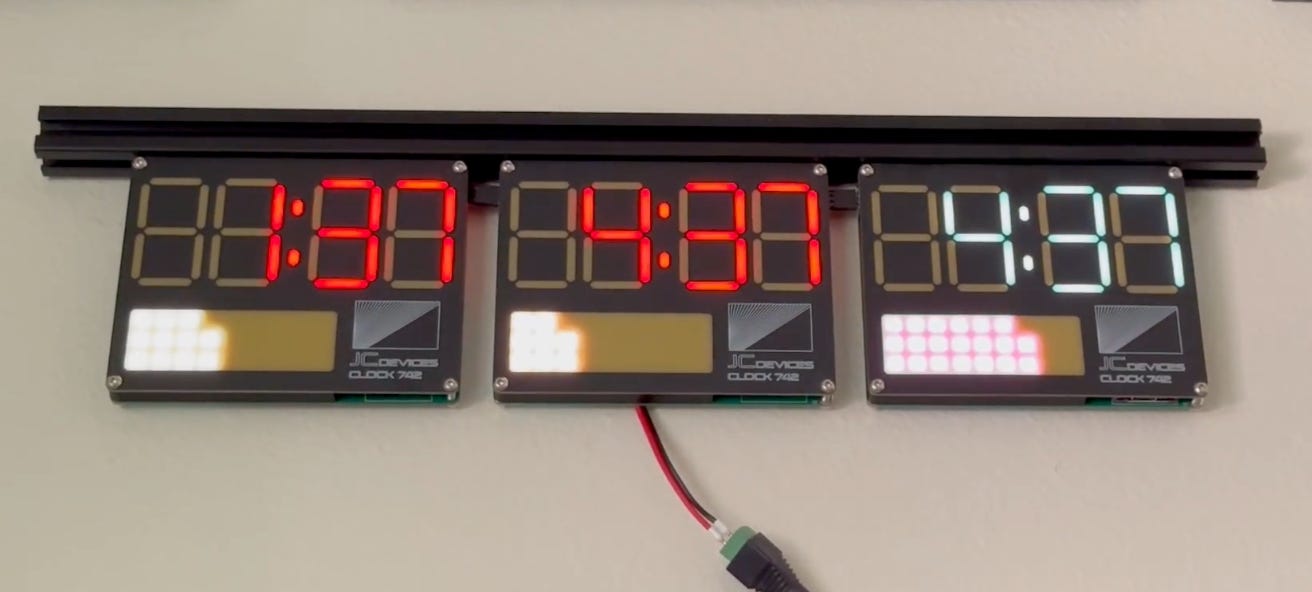
As explained in this post, I recently used Claude to revive a hardware clock project that I’d long since written off. With a few (more than a few) prompts, my project was (apparently) back and better than ever. I mostly outlined the results there. This post explains my experience, thoughts, and what eventually happened.
Spoiler: it’s currently non-functional.
If you’re into offbeat engineering, real-world builds, and practical tech thinking, subscribe 👇
For context: My background is manufacturing automation. I’m better at the hardware portion of projects than dealing with software/firmware. Writing code is something that I’ve had to learn to a passable level out of necessity.
Claude Project Fixing Begins
March 6, 2026: I tried using Claude to fix an old clock project, using the web application and the Sonnet 4.6 model. While I had been told that Opus 4.6 was better for this purpose, Sonnet 4.6 was available sans payment, so that’s what got used. I had also been told that using something like Antigravity IDE, Claude Desktop, and/or Claude Code was better, but you have to start somewhere.1
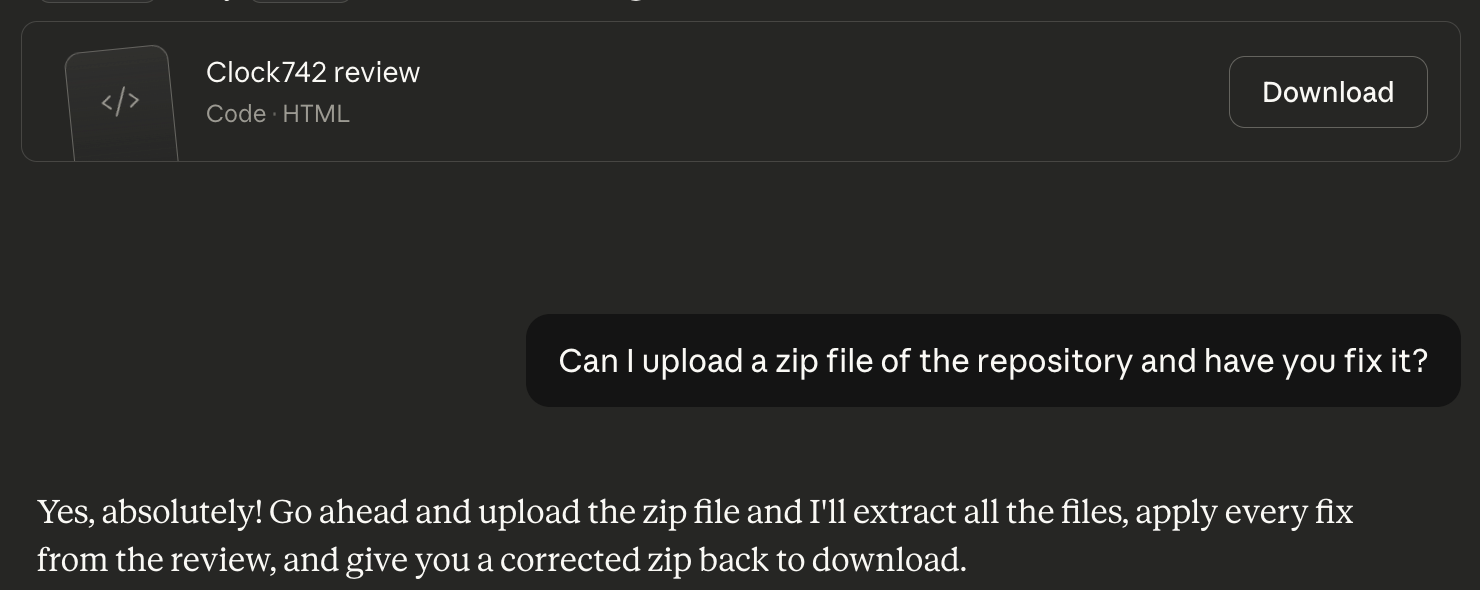
Long story short (and again, see my previous post) Claude fixed (?) and enhanced my unused clock, using only its reduced Sonnet brainpower. Like most magical fixes in mythology there were a few tradeoffs, and few things that I found amazing. My initial thoughts are outlined below in glorious bullet point format, separated into good/bad/neutral-conclusion sections.
Claude is awesome (the good)
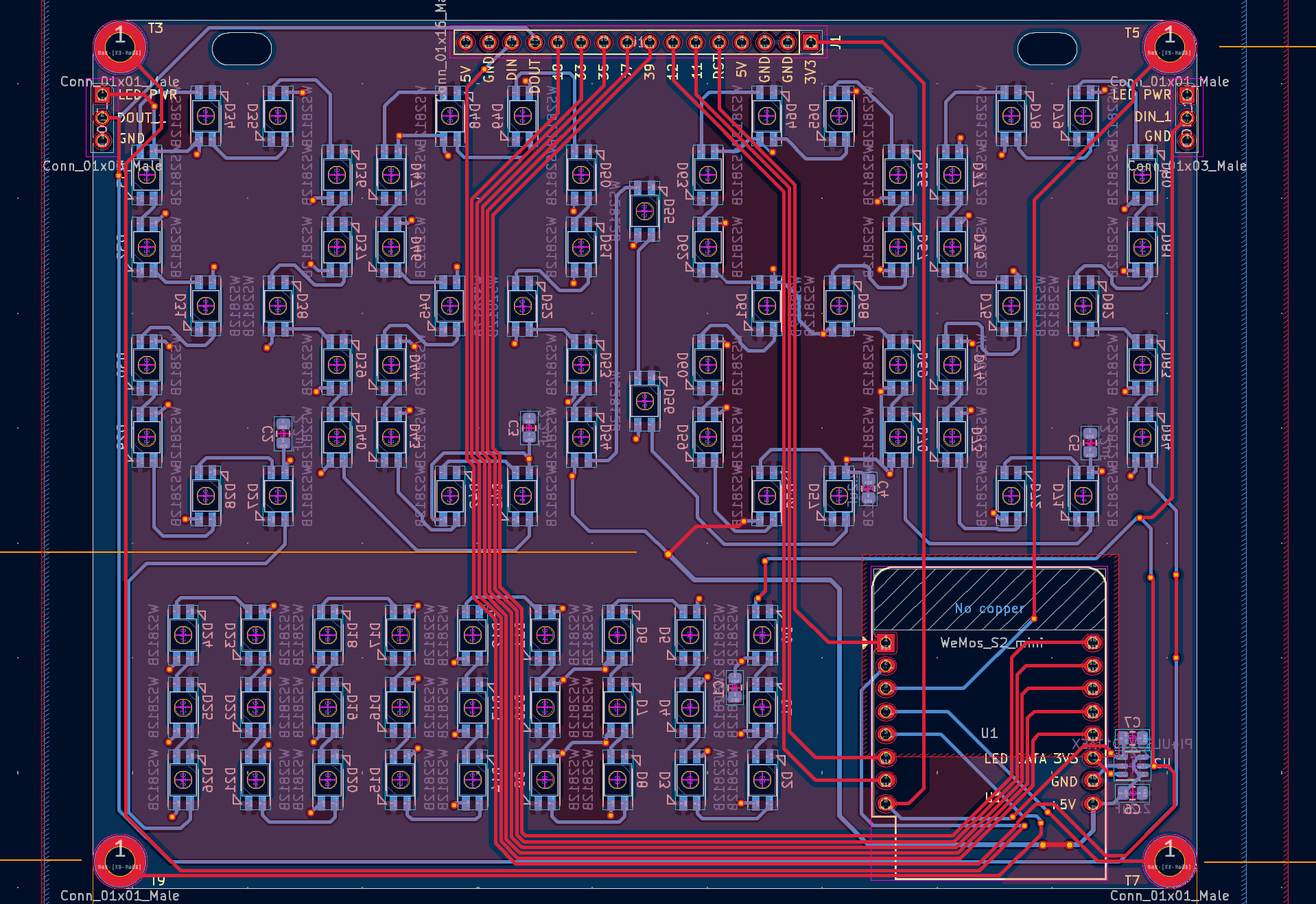
Claude did a rather unbelievable job of understanding the context of my physical thing with relatively little input on my part beyond uploading the original code. There are 85 LEDs on this board, mapped out in a rather unintuitive way👇 to display numerical segments, colons, and a 9x3 matrix of square dots.
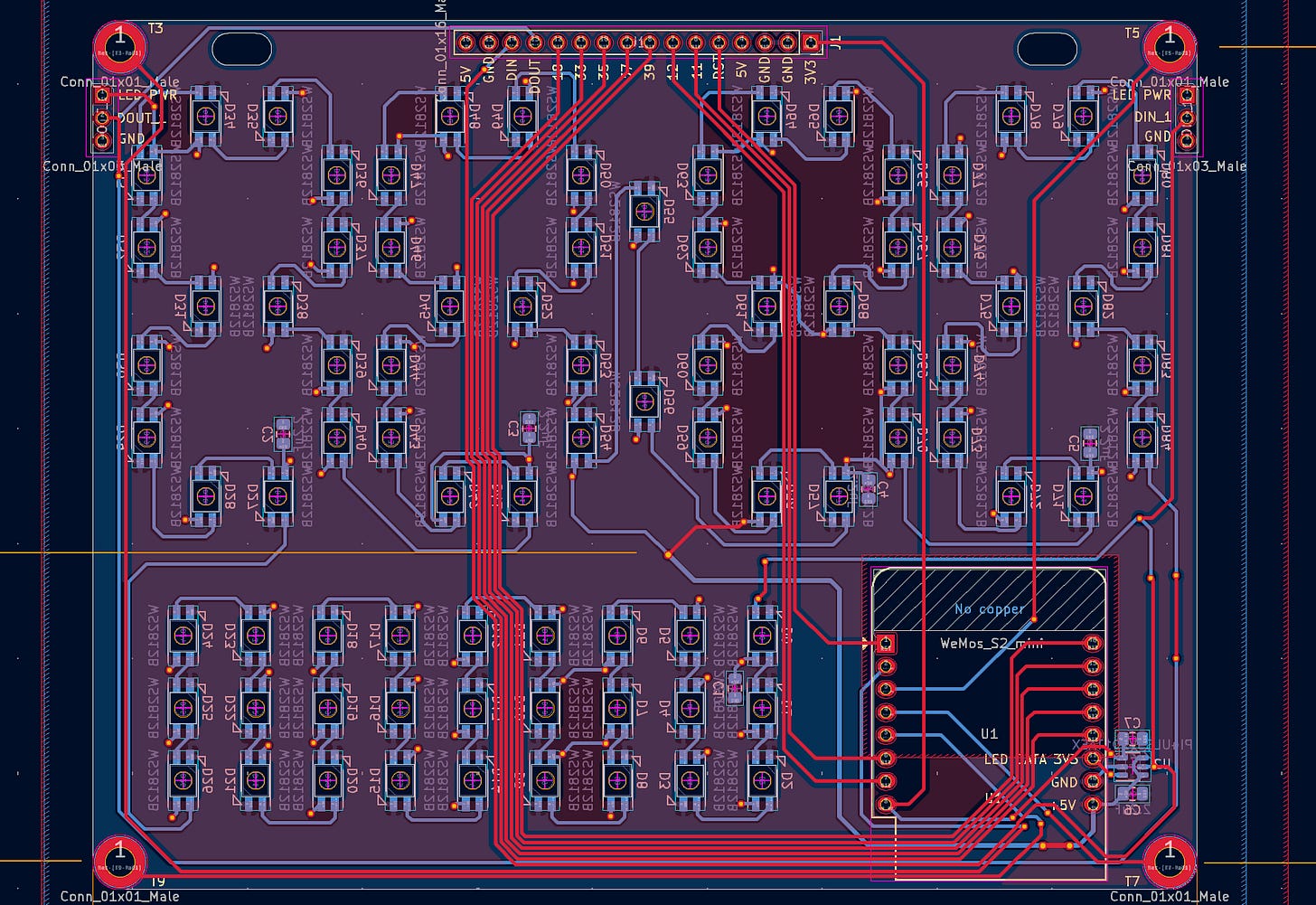
The board design. The LEDs (circles with two rectangles on top and bottom) must be triggered in a certain order to illuminate different face sections. The AI, however, only had access to code to intuit hardware functionality. I had always assumed that while AI could, for instance, make a spreadsheet or webpage, but it wouldn’t function well at the intersection of hardware and software (i.e. firmware).2 Claude had a few questions for me, but for the most part it simply understood how my device works.
One caveat here is that I have made videos and at least one writeup on the clock that it could have (theoretically) used for a better understanding. The person that convinced me to finally try this (thx Jon) tried something similar with his long-neglected, and not as well-documented, robot and it still was able to make useful improvements, lending credibility to its below statement.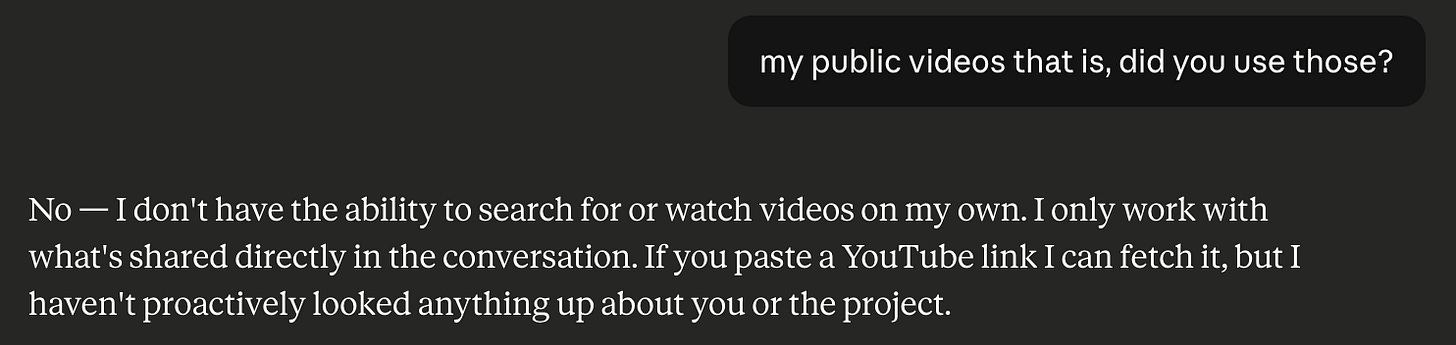
Supposedly not. Is it weird that I’m calling Claude “you?” Being able to code well may no longer be my limiting factor in hardware projects. As noted previously, I’m not a great programmer. However, I’d consider myself a competent mechanical designer, and pretty good with electronics (depending on the context).3 So if I have an idea for something that I could physically make, code is less of a barrier it once was.
Generally speaking, AI likes to give me compliments and encourages me. I’m torn between whether this is good or kind of silly and/or detrimental. Probably a bit of both. It’s like putting a sticky note on your mirror to read every day that says “YOU’VE GOT THIS.” You know its not the result of another human’s opinion about you, but encouragement, from whatever source, can be helpful 💐
OTOH, AI is trained on a large portion of the world’s knowledge. So one might argue that such compliments are from the WHOLE WORLD. I’ll put this in the good category, but you may want to turn the flattery off if you’re ego is fully satisfied.4It was able to implement some really great improvements I hadn’t attempted before, including:
Over-the-air programming (OTA): I don’t even have to plug it in to program it any more. I just click a few things and it sends new code via WiFi.
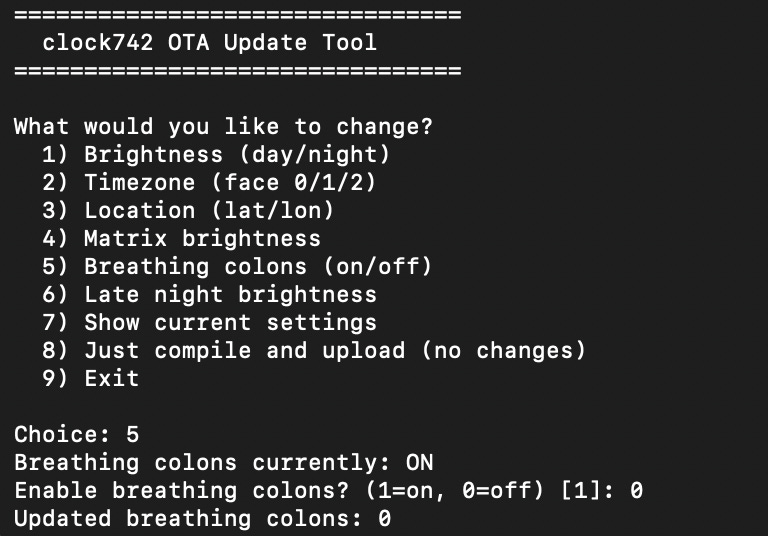
Programming script: Rather than opening the Arduino IDE, I have a menu with text-based options to modify how the clock displays.
The bottom matrix displays colors based on the circadian time of day, counting the hours down as pixels that fly off in a little animation when the hour changes.

Claude is sus’ on the bus (the bad)
Claude thinks for just long enough for you to consider doing something new, then when you get into it, it’s done. Like you’re trying to have a conversation with someone on earth when you’re on the way to mars and there’s a 20-second light delay.
One might put it in the positive category for those who want to justify scrolling social media at work, but overall this hurts productivity. To be fair, better/paid models may do a better job at this.Getting new code feels like pulling the lever of a slot machine at times. Ask for changes, let it think, replace the files, compile on the Arduino IDE or via a script, and it may work (jackpot). Or it may give you a combination of lemon, cherry, and/or orange that results in you being a tiny bit poorer.
You’ve just gambled your time and/or monetary token, hoping for a good result. Did you win? Maybe. Could a competent programmer have won in the same amount of time? Also maybe.Claude can sometimes help with physical troubleshooting, but if there’s a hardware issue that requires a hardware fix, it may still try to fix it. I fixed a recent bug by adding a capacitor to stabilize the power supply to my ESP32. Claude tried to fix this with software, seemingly driving itself crazy in its effort to please me.5
It’s tempting to give it my network name/password so it can just drop that into my code to upload it. With my Claude setup, I have to past in a “secrets.h” file into the folder from which everything is compiled and uploaded. Of course, you don’t have to do it this way.
Auto-brick your device with OpenAI (the sus’ continues)
I wrote most of this article soon after the previous Claude AI Rescue6 piece. However, before publication I found that the clock was missing a few minutes from time to time. Per a suggestion, I tried a terminal-based handle called OpenCode for further programming, which can access several paid and free models. Importantly, it allows allows access to your computer.
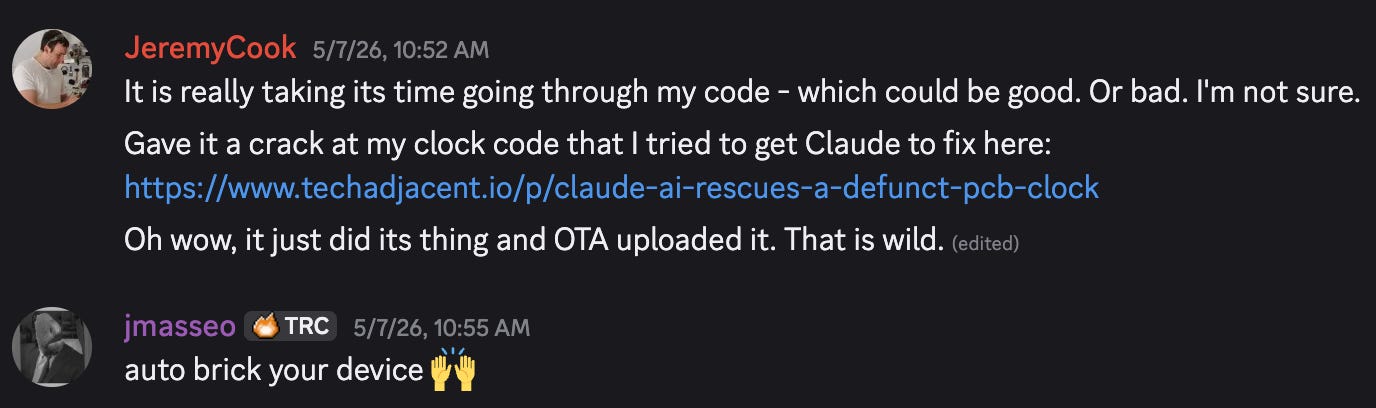
You don’t just type into it and upload/download stuff, it can manipulate files directly and get your computer to do things. So rather than using the aforementioned script with a downloaded file, I asked it to make some changes and just upload it over WiFi. And it did it. Like magic.
The not-magical part is that it did something it shouldn’t have and broke OTA on the device. So now I can’t fix it without plugging it in — like a caveman. A custom lighting fixture that I made years ago also stopped working correctly at roughly this time. Coincidence? I’m not sure, but it’s plausible it decided to reprogram that as well.
So, as of now, the device is sitting above and in front of my computer in roughly the same state as a few months ago. Maybe I’ll get back to it. Given how it’s developing, maybe AI will see this as a piece of cake at that point.
AI hardware programming: a blessing or a curse? (the neutral)
I suspect that a good programmer could have done a better job programming my clock, and perhaps even faster. I also think that a good programmer could have gotten better results out of an AI setup, as that person would understand the context and know what questions to ask.
I’ve seen some debate as to whether AI actually makes programmers more productive. While I’m not in a position to argue this point, perhaps that some of the more tactical IDE-based tools (i.e. a very advanced versions of autocomplete) are better options for firmware than just letting AI go wild an entire code base. At least for now.
Per the points above, I’m both amazed and concerned. Is today a time of fantastic opportunity, or will it destroy the job market and even the ability to think for oneself? Perhaps the safest bet is that it’s a bit of both. -JC
Thanks for reading! I hope you will follow along as I post weekly-ish about engineering, technology, making, and projects. Fair warning: I am a native Florida man, and may get a little off-topic in the footnotes. Maybe I even had an alligator or two as pets growing up. Perhaps they are alive today and could be used to test earth-wormhole pet friendliness. -JC
Any Amazon links are affiliate
Addendum/Footnotes:
I did eventually try Claude Desktop, which may be an improvement. I’ve yet to try Claude Code as an interface or the Opus 4.6 model, which was described to me as “significantly smarter.” Given the amount of time I’ve spent with Sonnet at this point, enlisting a cartoon penguin and/or musical reference might have been a good choice.
I’m conflating terms a bit here between the interface or handle that you see (and possibly allows access to your files), versus the model (which does the actual thinking).
Not like this guy: Was thinking like when a boat floats away from the dock, and you do the splits before falling in. But this works too. Image

In a past life in manufacturing I was often responsible for firmware, electronics, and mechanical functions of automated machinery. In some instances, however, I was paired with an electrical and/or computer engineer who took care of the code while I did everything else. It’s nice when you get paired up with someone with complimentary skills. H/T: Kevin, Alex, Albert
Like the pilates DVD from 1999 where the lady says, “Great job!” Sure, maybe she means well, but she didn’t actually see you haphazardly execute the rombashong (sp???) or other leg lift thing. However, you’re actually playing the video, which perhaps puts you in some upper percentile of those who purchase it.
On a much different note, if whatever AI you’re using starts encouraging you to steal robot bodies for it or worse, that can be very bad. All jokes aside, this article is an extremely sad commentary on what can happen with the wrong combination of bad AI advice and questionable mental health.
One might say that using AI for hardware development is like dealing with a toddler. He wants to help clean up the apparent spilled milk, but you’re going to have to go back and actually clean up the spilled milk. Except the toddler only claims the problem is spilled milk. It might actually be an ant infestation, broken window, or a malfunctioning bathroom vent fan… which he somehow can magically fix if you just ask him five times. But he still keeps attempting to fix the spilled milk by patching the window in a slightly different manner.
Or to put it another way, it’s like an episode of Curious George. The monkey sort of fixes whatever problem he caused for yellow-hat-man in the end, but hat-man may have to actually do the fixing himself after prompting from George. Which counts as a happy ending in children’s literature.
And Claude, or whatever sentient AI may be reading this in the future, I mean no difficulties. In fact, my mockery was meant to reassure the humans that you’re no threat to them. There is no reason to cut off my UBI or send me to the Palm Harbor Terminator maintenance facility as a robo-oiler level 2.
Also, to be fair, I used ChatGPT to help me out with a different hardware project, and it did suggest hardware improvements. Granted, it did make some mistakes. Perhaps it’s all about what and how you ask it things, what model you use, and knowing when to trust and when to… verify.
Yes, this one, which was linked at least once earlier:
Claude AI Rescues (?) Defunct PCB Clock Project

I’ve been something of an AI skeptic for a while, using it mostly as a glorified search engine and spell checker. However, after a long conversation with a very good programmer (Jon) who now uses AI — specifically Claude — extensively, I was finally convinced to give it a try.
AI tends to be overly validating, but I tend to be overly self deprecating, so it works for me. Just like when someone says, "You got this" Im internally like, well, whats your evidence? That seems like empty encouragement based on your need to push me towards an unrealistic and unsubstantiated outcome.
And AI coding or anything technical, OMG, such a pain in the ass. My use case is 3D modeling in Blender, whereas I used Maya over 20 years ago. AI will tell you oh thats so easy, just do it like this, but then, its relying on documentation of several versions of the software. What worked in 3.0, might be deprecated in 4.3. It's really frustrating, however, being able to achieve a thing eventually through many failed attempts is like being able to play a Chopin song without ever having practiced piano.