

I’m always building something, and years ago I had the idea1 to make a drum machine that would tap out a beat on a tong drum, sort of like the steel drums you may associate with Caribbean music. I envisioned a microcontroller or similar that could be programmed plink out a beat using solenoids.
If you’re into offbeat engineering, real-world builds, and practical tech thinking, subscribe 👇
A multi-part challenge
Designing such a system would involve several distinct parts/challenges:
Mechanical structure to hold the solenoids in place
Microcontroller or other device acting as the “brains”
Modular user control linked up with the venerable 5-pin MIDI interface
-Somewhat optional, but it did lead to the product idea
Each of these parts required a novel solution, and the MIDI/Serial/I2C adapter that I came up with for the last bit turned out to be something that others could use. I turned it into an actual product, even though it was only a small part of my overall project.
The Drum Mechanism
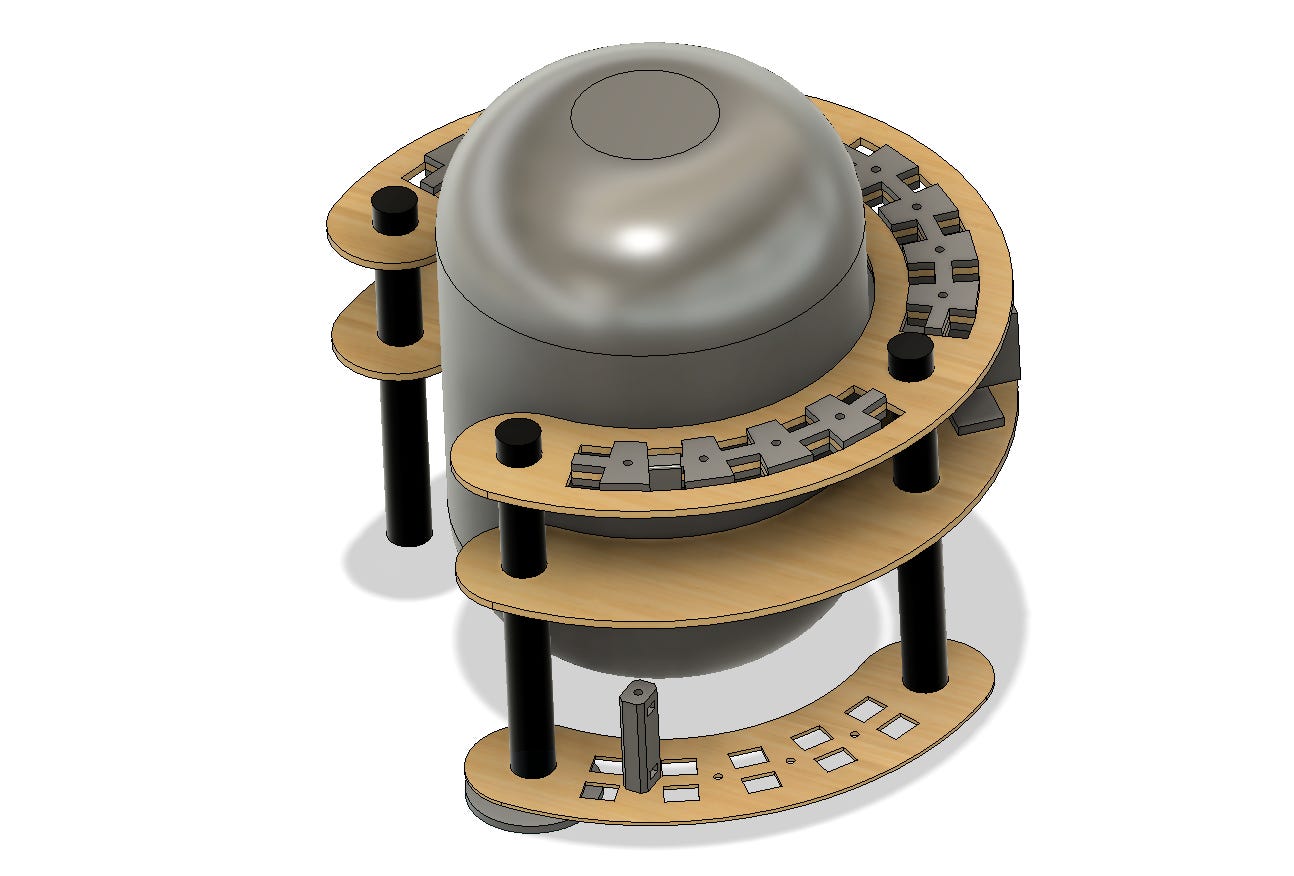
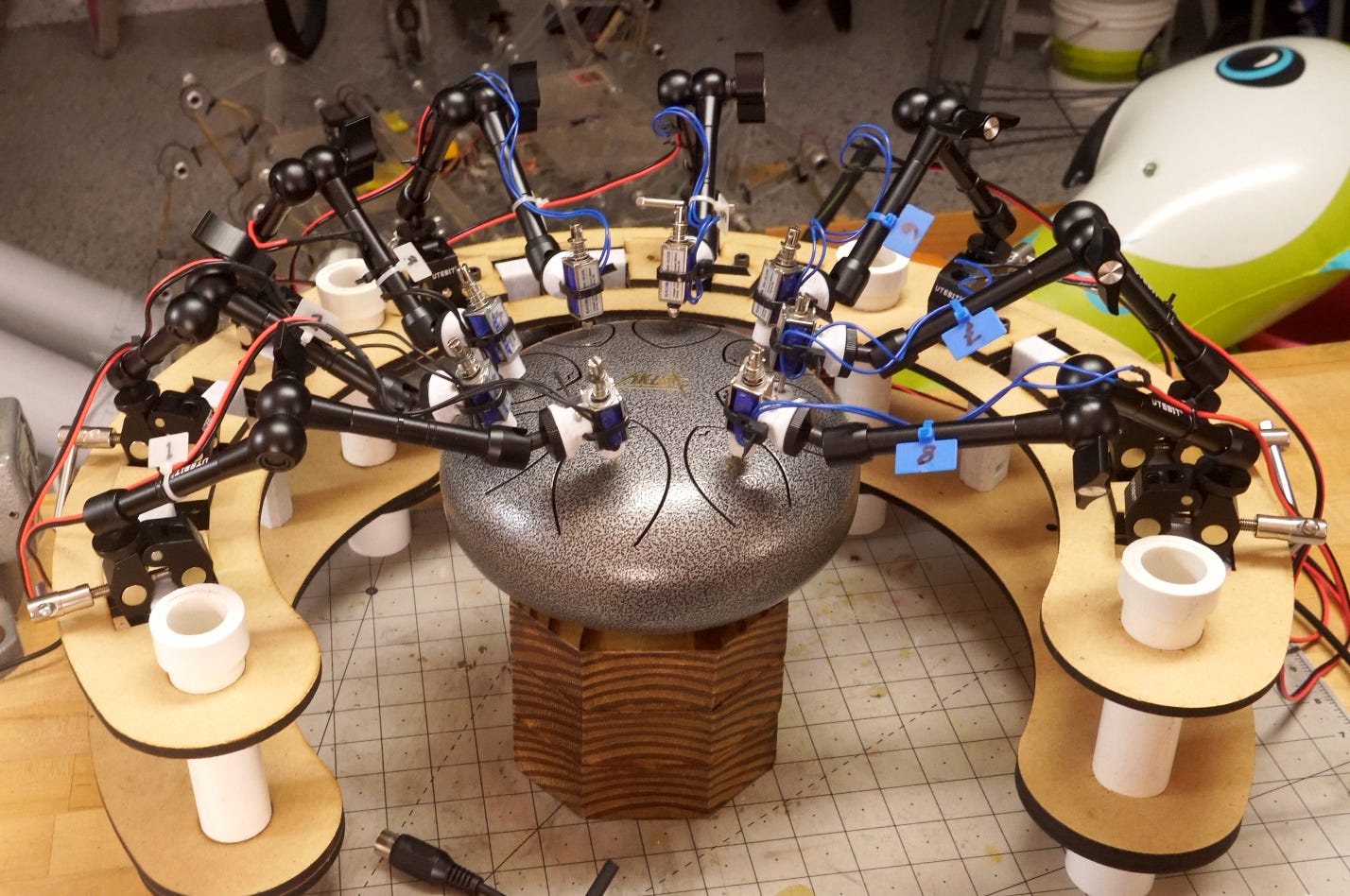
I designed the machine in a semi-flexible “C” configuration, at least partially inspired by the distinct look of Cray-2 supercomputers. The slots on the top are designed to allow adjustable friction arms — generally used for camera equipment — to attach and grip nicely. It’s an extremely versatile setup, theoretically accommodating a tank drum as shown above, or the Amazon-sourced steel tongue drum that I eventually went with:
The Arduino Opta PLC & SSR Expansion
Mechanics aside, how can I drive the solenoids that bang on this drum? A typical Arduino (e.g. an Uno) can’t power such devices without a lot of external circuitry. However, Arduino had recently came out with a small PLC, and a solid-state relay (SSR) expansion module that can fire the solenoids without making any noise. Even better, I got both of these units for review purposes, making my price quite attractive at $0.
Problem + MIDI deep dive = successful product!
There was just one little problem. I wanted to use an external MIDI2 controller as the device’s user interface, and there (was) no ready-made MIDI-to-Opta adapter. Also, I knew very little about MIDI.
The good news is that the ancient MIDI spec — which dates back to the early 1980s — is fairly easy to understand, and is basically a serial signal. If that sounds like gibberish, the important part is that it didn’t have an easy way to communicate with my Arduino via either serial or MIDI. I had to make an adapter myself to talk serial/MIDI. I also broke out its I2C3 communication capabilities on this adapter, as it was rather easy to add and greatly enhanced its usefulness.
The neat thing is that it appears this problem hadn’t yet been solved, and I’m not the only one that could use a way to interface externally with the Arduino via I2C and/or serial. Once I’d figured out the correct connector and pinout4, the design process was rather simple.
While others could have figured this out pretty easily, I believe I was the first, and there’s certainly an advantage to being the or among the first people to build a product. It’s a bit of a niche product, so while my customer base will be limited for the foreseeable future, any potential competitors probably have better things to do than squashing my enterprise.
A Semi-Musical Journey of Learning
You might assume that there is always an off-the-shelf solution for problems that you run into. However, when you’re dealing with newer and/or less standard hardware, that isn’t always the case. If you see an opportunity, even if it’s only adjacent to the overall project you were working on, consider jumping on it.
In this case, the Arduino Opta was the new kid on the block in the PLC world. Since I wanted to make a neat project with it, I had to come up with my own communication setup. Since its publication in August 2024, I’ve sold somewhere around 200 of these Arduino Opta I2C and Serial I2C Aux breakout adapters, netting a pretty decent profit5 for something that was simply a side-effect of another project.
As for why selling something where my profit/unit is well under $10 could potentially be worth my time, see article👇
Sell Your Small-Batch Thing in Multiples for Extra/Acceptable Profit

For several years I’ve maintained a storefront on online retailer Tindie. Unlike Tinder, which its search listing describes as “Dating, Make Friends & Meet New People,” Tindie “is a marketplace for maker made products.” Over the years I’ve grossed close-ish to $20,000 and fulfilled 627 orders. Interestingly, I have met several friends and acquaintances through Tindie, so maybe it's selling itself short.
The Videos
Yes, I make YouTube videos, which are less-moderately-successful than my buddy Pocket836. Below is the promo video for the Arudino Opta aux out adapter, and the drum video is after that. There are a few other videos on my (main) YouTube channel that relate to this project, as the whole thing was quite a learning journey. I also put up more exclusively audio-focused stuff on this “Cooked Audio” channel, though I struggle with where to draw the line between the two at times.
Experiment, Solve, Profit
So what’s the lesson here? If you’re like me and enjoy making things — and experimenting in areas that may be brand new — pay attention to any ancillary doodads that you have to invent in order to make your main project work. I doubt I’ll ever sell a robot tongue drum (get in contact if you want one👇), but the I2C/Serial/MIDI adapters that I had to make to make this happen have been moderately popular.
There’s a similar story with my EZ Fan 2 board, which I developed when I wanted an “EZ” way to control a fan on a Raspberry Pi SBC. I’ve sold upwards of 750 of these devices because others had the same sort of need I did. For various reasons, sales have slowed down considerably, and I may retire (or not restock) it at some point, but it was my first real foray into the world of custom electronics sales.
So pay attention when you find a creative solution to a problem. Others may need it too!
Techadjacent is where I share engineering ideas, builds, and practical tech analysis. Subscribe to get the next post in your inbox — published weekly👇
Thanks for reading! I hope you follow along on this Techadjacent journey. Fair warning: I can and do get a little off-topic in the footnotes.
Note: Some links may be affiliate
Addendum/Footnotes:
Along with my cousin and musical collaborator Jackson
MIDI = Musical Instrument Device Interface. The standard interface for shooting music control signals from device to device.
I2C - Inter-integrated circuit. Allows several integrated circuits to talk to each other. As with serial, also an ancient communication technology, still very much in-use today.
With a bit of help from Kevin at Simple DIY Electronic Music Projects via their Discord–a great resource for… simple DIY electronic music projects. Kevin is quite knowledgeable about such things.
As I sell a lot of these in “2-pacs,” which aren’t properly accounted for on my Tindie store, I’m not entirely sure. My accounting here is pretty slack, but I’d estimate I’ve netted between $1000 and $2000 + whatever value I can attribute to being able to talk about it here and on other platforms.
As previously mentioned here. Incidentally, Pocket83 also introduced me to David Foster Wallace and his liberal use of footnotes, which one might argue that I’m emulating/copying/ripping off/doing a worse job of here. And perhaps that is true in some sense. Of course we’re doing that all the time as a society: using a wheel, making an instructional YouTube video, when I used nan bread in lieu of a tortilla and re-invented the Taco Bell Gordita, or any number of other things that we human-GPT together.