

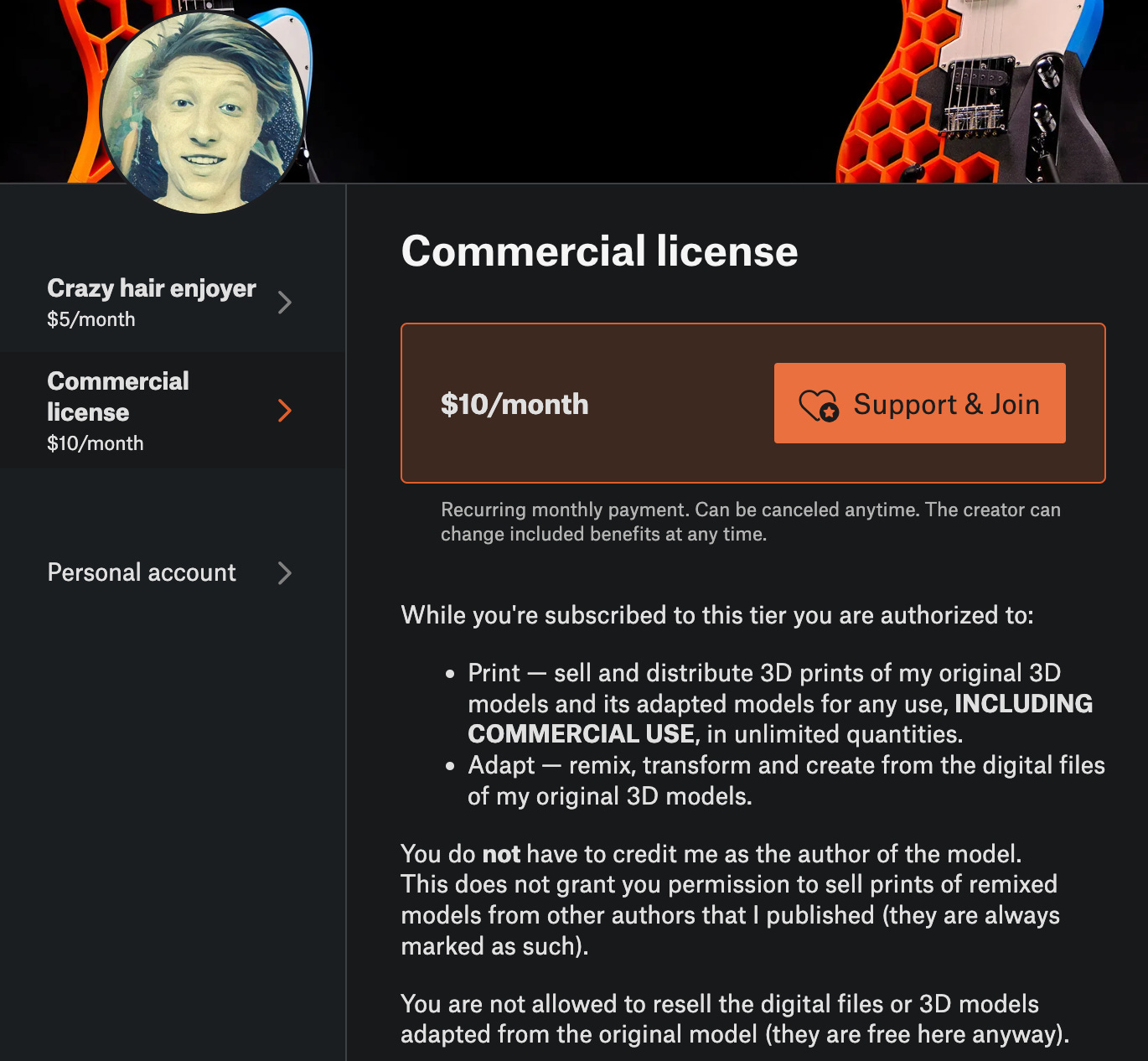
Some time ago, I made a new version of the 3D-printed Prusacaster design for Hackster.io. Whether or not this counts as commercial use seemed a bit nebulous at first because they will be giving it away, but I paid for the $10/month commercial license1, which I think was the right thing to do. Besides, it’s good to support people who make cool stuff, especially when they provide STLs (print files) and the CAD models for easy modification.
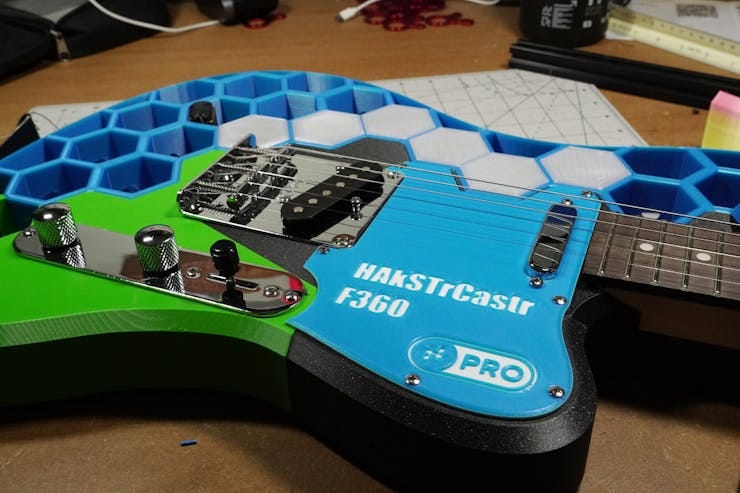
The resulting guitar is shown above, with build details available on Hackster.io (which commissioned this project) and any future mods to be published on Printables. You can even (in theory) mix-and-match parts from the original and my design for something truly unique.
The question is who owns my new design? Is it me? Hackster? Original author Mikolas Zuza? Anyone? Does it even matter? Am I being overly legalistic even worrying about this? I have thoughts.
If you’re into offbeat engineering, real-world builds, and practical tech thinking, subscribe 👇
What is the point of open-source designs?
First, I don’t think you have any moral obligation to release your designs as open source. However, I’ve benefitted greatly from open-source projects like KiCad, LibreOffice, and a wealth of other software and hardware designs — way too many to name if I even knew the name of all of them. So it seems like a good thing to “pay it forward” and advance the ecosystem.
There are several good reasons to put your design out there for free, including:
Let others make your thing and enjoy it
Chances are your new device… let’s just call it a butter-opener fork won’t get enough commercial traction to make it worthwhile (though maybe you can sell in multiples). And if you design and make something for just yourself, it likely won’t be worth your time.
However, if you put it out there for those 100 people who would like a butter-opener fork, and who can print it themselves, you’ve made the world just a tiny bit better while enhancing your reputation… just a tiny bit.2
Let others build on your design & even give you feedback
Maybe the butter-opener fork would benefit from a spoon on the handle. As an open-source design, someone (lets say Jill) can just add that in and post it as a “remix” of your design.
-I’ve done this myself, in the form of split Harbor Freight bin (my most popular design on Printables).Someone may suggest a change to your code and/or CAD model that you can directly integrate into your own design. A win for everyone.
The problem — for (overly?) honest people
So what happens if someone (Jack) takes the butter-opener fork/spoon made by Jill and tweaks it to the point where it can be a commercial success? If you put it out via a non-commercial license, Jack (apparently) can’t use the design, even if he was to give you a cut of the profits… unless he also negotiates with Jill, who perhaps can’t be contacted for whatever reason.
No one can then profit from Jack’s design, and people can’t get the improved butter-opener fork/spoon that they so need and deserve, except for those that are willing to print it themselves. Or, someone less scrupulous(?) might just make the butter-opener fork/spoon and sell it, daring you, Jill, and/or Jack to sue him.
Which you won’t, because it’s really not worth the hassle… and is it enforceable/legally binding anyway?3 In theory, if your design is artistic, it could be subject to copyright, but something that is purely functional is not. Defending your presumed rights to such a design, even in the case of large guitar companies that have real money to loose, is fraught with difficulty and expense.
What is commercial use?
At it’s most obvious, commercial use of a design is making something (often 3D-printing it) and selling it — even if the author says this is a no-no. But what does “commercial” include?
When I made my new guitar, it was for a giveaway, and the product was mostly the video and media having to do with it. Here I would lean toward the “it is commercial” stance, because I was effectively selling it to someone. But what about the many YouTube channels that take an open-source design, make it on camera, credit the author, then profit via the video? I doubt all of them have an agreement with the original author.
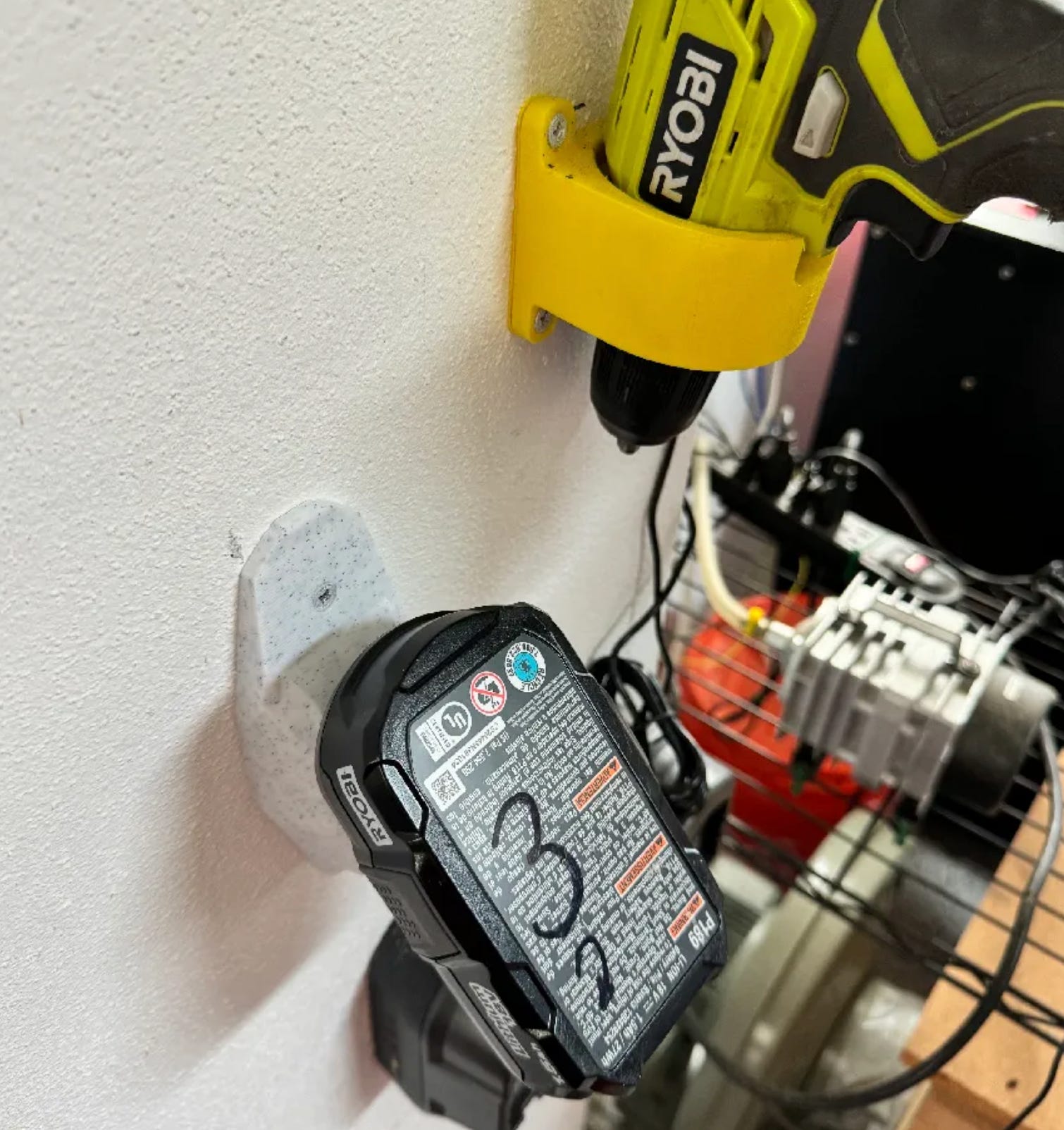
What about if you have a commercial shop and need somewhere to, say, store batteries?👆 You see a design online, print it out, and use it as intended. You’re making profit off of this indirectly, but aren’t selling it per se. I don’t think this is what’s meant by “commercial use,” though you could certainly make the argument that it is.
I certainly wouldn’t sue, or probably even complain, if a company were to use a few of my designs to help with their processes. Besides, how would I know? There are bigger problems in the world. The general idea of non-commercial use seems to be that you shouldn’t churn out thousands of someone’s design for direct sales, while the original author sees none of the profits (even if it may be legally permissible).
My invention - sold by others without permission (it’s OK)
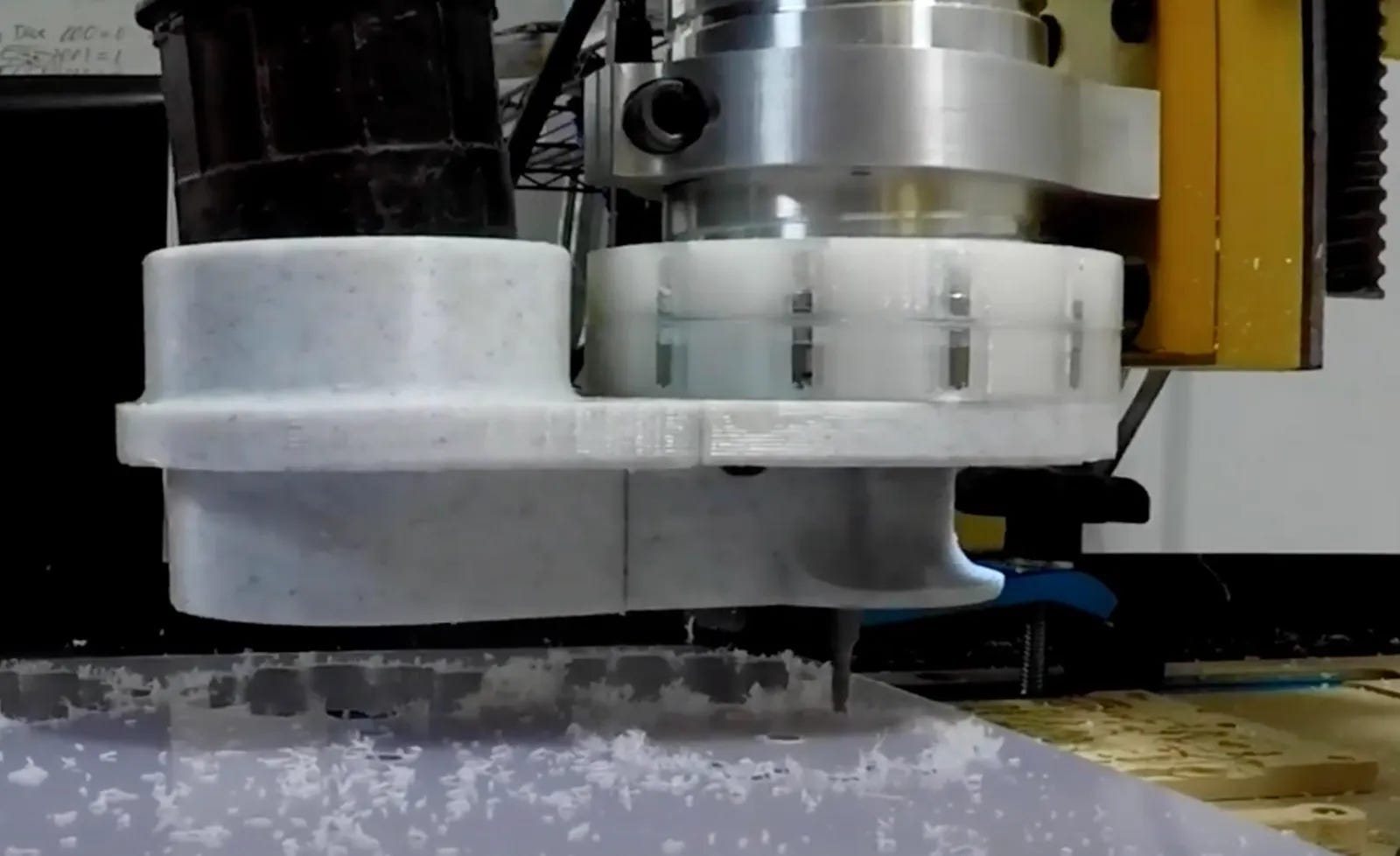
Years ago, I designed this dust extractor for my CNC router, which became rather popular at the time. I was told that the printed version was for sale elsewhere — without my permission. It kind of made me cranky, but besides a possible email or two there was little I could do about it. Plus, I think I just put it out there without any sort of license originally, so my legal and/or moral rights were tenuous at best.
I wasn’t personally selling it, and it seems that others were there to fill the gap in demand. Perhaps I should have jumped on this opportunity and started turning them out and/or sold the design. Hindsight is 20/20 as they say.
Example: paracord tensioner — an array of “violations”
As a weird example of how this all gets rather convoluted, consider “my” paracord tensioner design, found here on Printables. As I put it in the description:
Modeled this version from scratch, based on the STL found here. Which is apparently based on something called a Loop Alien. Or probably a knockoff Loop Alien, which was then adapted as a 3D-printed device. Wild how things develop. This is released as public domain with CAD files. Enjoy.
In other words, my model is 4-5 iterations removed from the original idea. So it only seemed right to release my design as public domain that anyone can use, and I suspect it doesn’t matter anyway. You can also just buy knockoffs of Amazon, along with the actual paracord. Those tensioners are inexpensive, and certainly way stronger per their aluminum construction.
Does the license actually matter?
Since functional things aren’t generally subject to copyright (even if the files used to make them could be) and you (likely) don’t have a patent on the design, bringing a lawsuit for perceived licensing violations would be fraught with difficulty. One could argue that a functional thing, made from open-source materials, aren’t subject to any sort or restrictions legally speaking, unless there is a contract involved.
Mostly confirming my thoughts, Perplexity’s opinion reads, in part:
The non‑commercial license on a 3D design file is generally legally binding as a matter of copyright licensing. The problem is that copyright does not cover everything the physical object does or is.
If the main value of your design is functional, and you genuinely want to control commercial manufacturing of the physical objects, you need to think in terms of patents, trade secrets, or contractual arrangements, not just a NC label.
If you mostly care about people not commercially exploiting your models or artistic prints (e.g., miniatures, logos, decorative objects), a non‑commercial Creative Commons license can be meaningful and enforceable, especially against obvious commercial re‑use of your exact files and designs.
Of course, this doesn’t mean all uses are morally right, but some entities will respect your non-commercial licensing/wishes. Some likely will not.
While there are reasons that you might want to use such a license and/or state other restrictions, you could also consider simply putting your thing out there as public domain so people can use/modify/integrate your work without worry. Or add a watermark if you really want credit.4
This is my opinion, IANAL
In summary, “owning” a functional design is not as simple as stating your license terms. And unless you’re making cutting-edge chip manufacturing machinery, whatever you made is likely pretty easy to reverse engineer with a good pair of calipers and/or inexpensive test equipment anyway.
As for the guitar, I suppose I own my new modifications in some sense, but not the guitar design as a whole. One might also argue that my mods are more functional than artistic, while Mikolas Zuza’s portion is more easily classified as art. So could he technically produce my design commercially without permission, but not the other way around? I’m not certain. At the end of the day, it’s a bit of a conundrum that wouldn’t be worth litigating. Perhaps the right attitude is: treat designs and each other with respect, but don’t get too hung up on the details.
Please take this article as food for thought. It’s mostly based on my opinions/observations. I have some some limited research for the piece, but not nearly enough to make me an expert in the field! I am not a lawyer, I’m just a guy who likes to make things.
Techadjacent is where I share engineering ideas, builds, and practical tech analysis. Subscribe to get the next post in your inbox — published weekly👇
Thanks for reading! I hope you follow along on this Techadjacent journey. Fair warning: I can and do get a little off-topic in the footnotes.
Note: Some links may be affiliate
Addendum/Footnotes:
Considering this in retrospect, it seems this would very much be a commercial use. As far as payment, likely they paid for it, but I’m not sure. Things got a bit muddled with this project, but at the end of the day I think everyone was happy.
Provided said butter-opener fork is food safe and doesn’t get anyone sick. I have no official opinion on this particular invention. Use your own judgement here.
I’m not a layer, but enforceability (especially across jurisdictions) is actually a pretty interesting question. My understanding is that copyright applies to written works, which, thanks to Disney, now extends to around 500 years (jk, mostly), and is automatic when published. Patents, however, apply to “things,” typically last up to 20 years. You can also maintain trade secrets indefinitely, which wouldn’t apply at all if you’re sharing something online.
So is the product of the open-source design protected whatsoever? I actually don’t think so. And if it was, couldn’t you just design the exact same thing and pass it off as your own? And if you’re selling a thing, who’s to say what is in the design file that produced it? That doesn’t necessarily make all uses right, but it’s certainly nuanced.
If you have a path for licensing your design to an entity like Print Kits that would respect your non-commercial designation, it might make sense to keep it that way. Also, it’s great to put your CAD models out there for easy modification. However, if it’s important to you to have your name/mark on prints for attribution, this also makes it easier to “scrape” your name off of it.