

As outlined in this post from about a year ago1, I’ve been enjoying and growing pineapples here in Palm Harbor, Florida for quite some time. While the literal fruits of my labor have been few and far between (two actual edible pineapples), The plants themselves are hardy and rather pleasant looking.
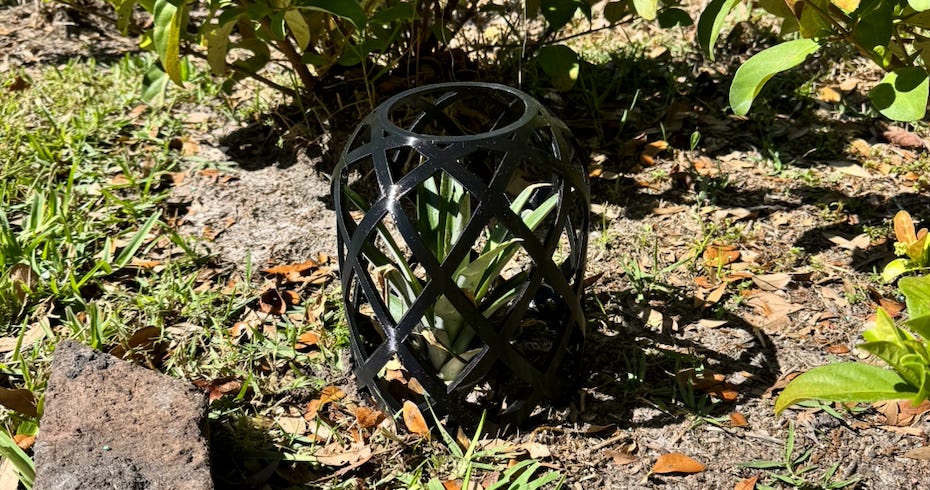
And the plants are available for free after you eat the pineapple itself. Sort of like the adult version of the toy that used to come in your sugar-based cereal. Just chop the top off, let it dry for a bit, then plug it into the ground. If it actually produces more fruit, that’s just a bonus.
If you’re into offbeat engineering, real-world builds, and practical tech thinking, subscribe 👇
Pineapple growth problems
The problem is that local deer like to test the young pineapples by yanking them out of the ground and/or the lawn workers blow them out via leaf blowers. Or maybe they wack them as if they were weeds, I’m not certain. What I needed was some sort of structure to protect the baby pineapples until they are firmly rooted in the ground.
And, yes, you might point toward chicken wire or other more traditional fencing. But that wouldn’t be much of a Techadjacent Novel Use Case (NUC) article.
I considered modeling something myself, but in this case a quick search of Printables yielded this Anti Pest Plant Cage. As designed, it’s much too small for my purposes, but scaling it up by a factor of 363.64 yielded a structure that would just barely fit on my Prusa Core One printer and is big enough to enclose a small pineapple.
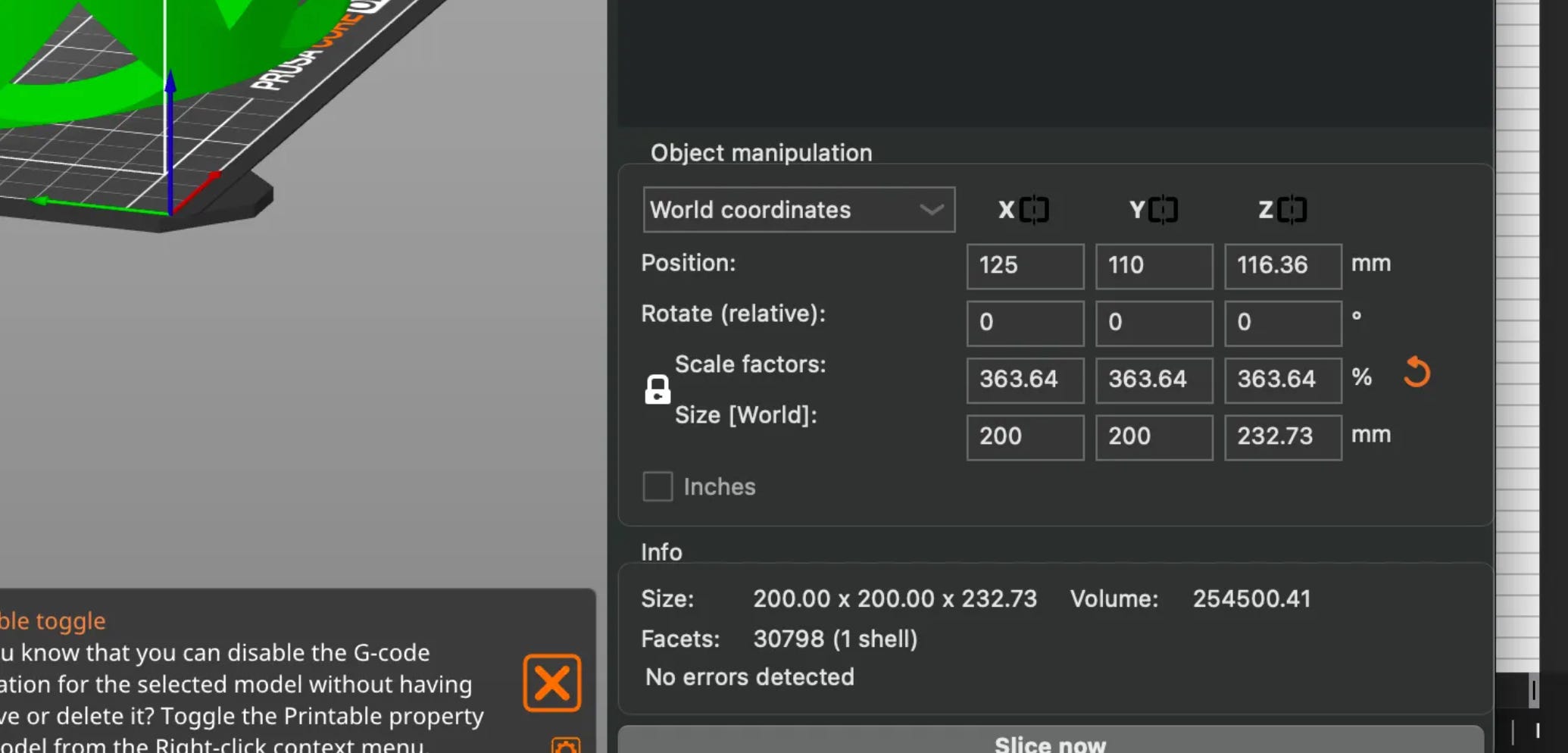
I also scaled the stakes in a similar manner, but restricted the height to 150%. This gives them sufficient width, but also allows them to stick in the ground sufficiently.2 The cages do take a while to print, but it’s not like you have to watch the process. At this point, I have several protecting my pineapples. None of which have been destroyed or ejected from the ground.
Hexagonal trellis
I also found these 3D-printable modular trellis… ises, which are meant to stick together with some little connector pieces. While they seem to do the job, and look nice, I honestly wish I’d printed them a bit thicker as I’m not sure how well they will withstand the elements.
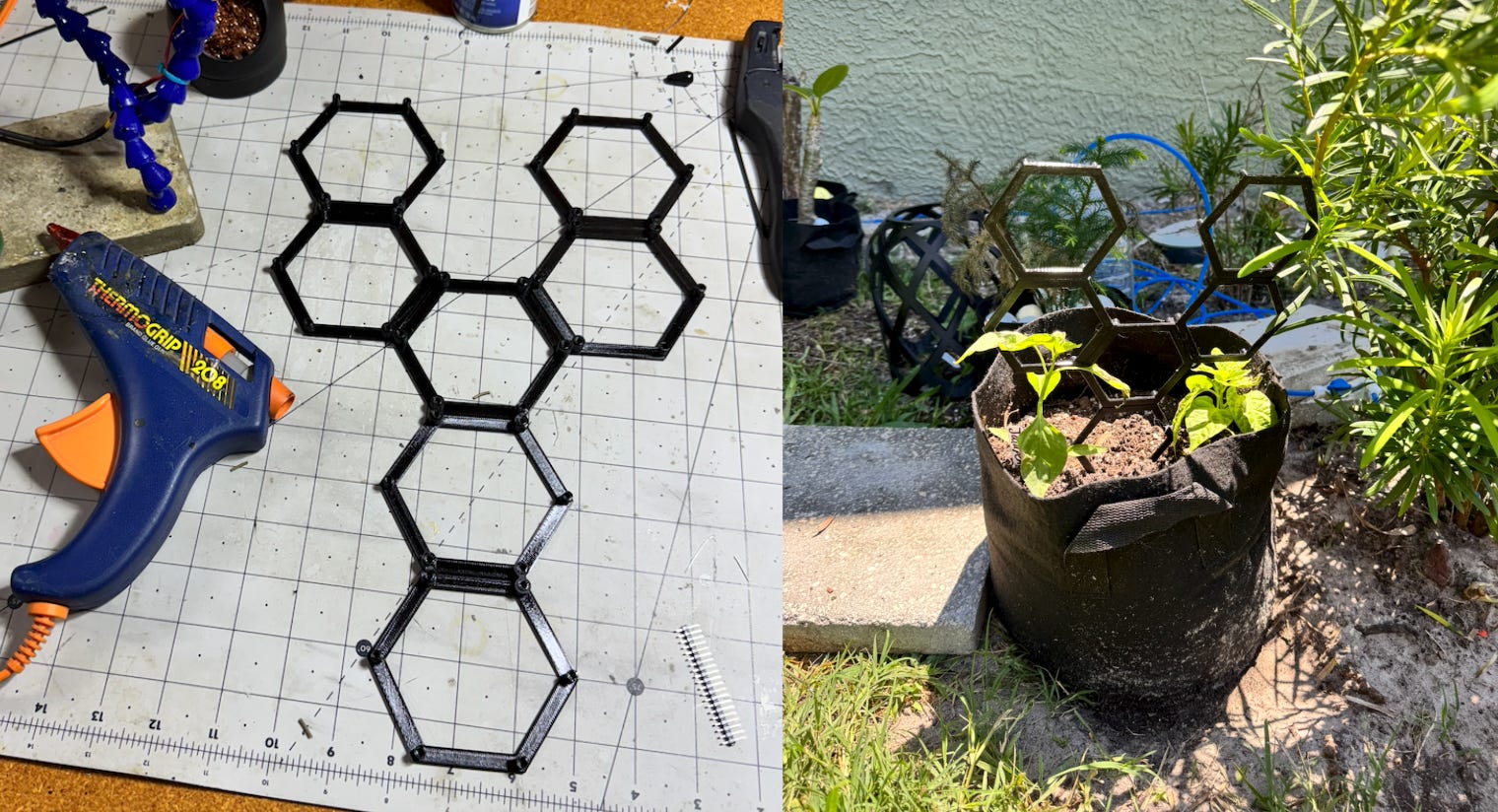
Some stakes would also be a welcome addition. All that said, the author was nice enough to make the Fusion 360 model file available, and used a rather permissive license for it (whether it matters or not, it’s still a nice gesture).
So it would be quite easy to change things around if I was so inclined. I gave the model a 5 star rating.3
Bonus: 1.5 gallon jug
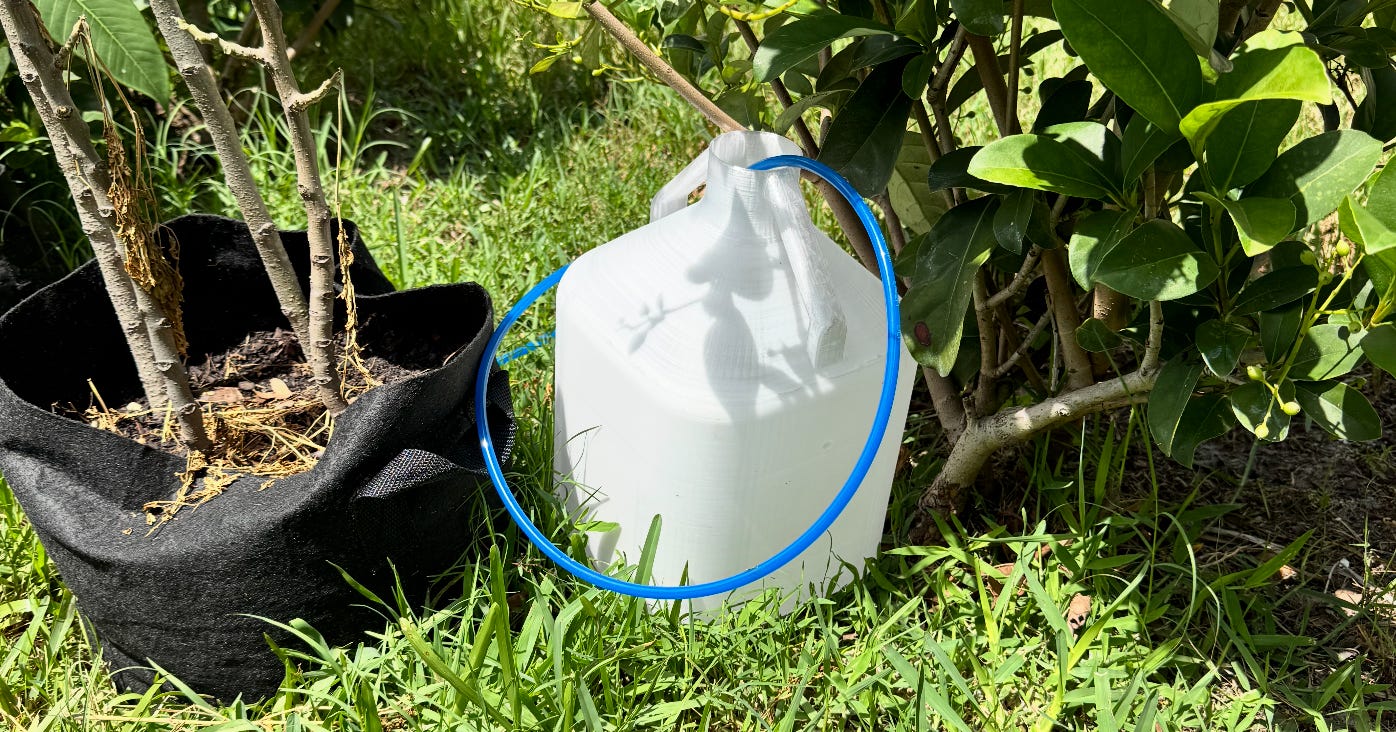
I’ve been feeding my air condenser condensate water (as explained here) into a jug as of late so I can water other plants. However, I wanted a jug larger than a gallon, but it seems you usually have to pay for such a device. So instead of paying $5 or whatever, I ordered ~$18 worth of translucent filament and spent an hour or two modeling one that would fit my purposes. What a bargain!
Here are the files if you want one yourself.
3D-printing opens up unforeseen possibilities
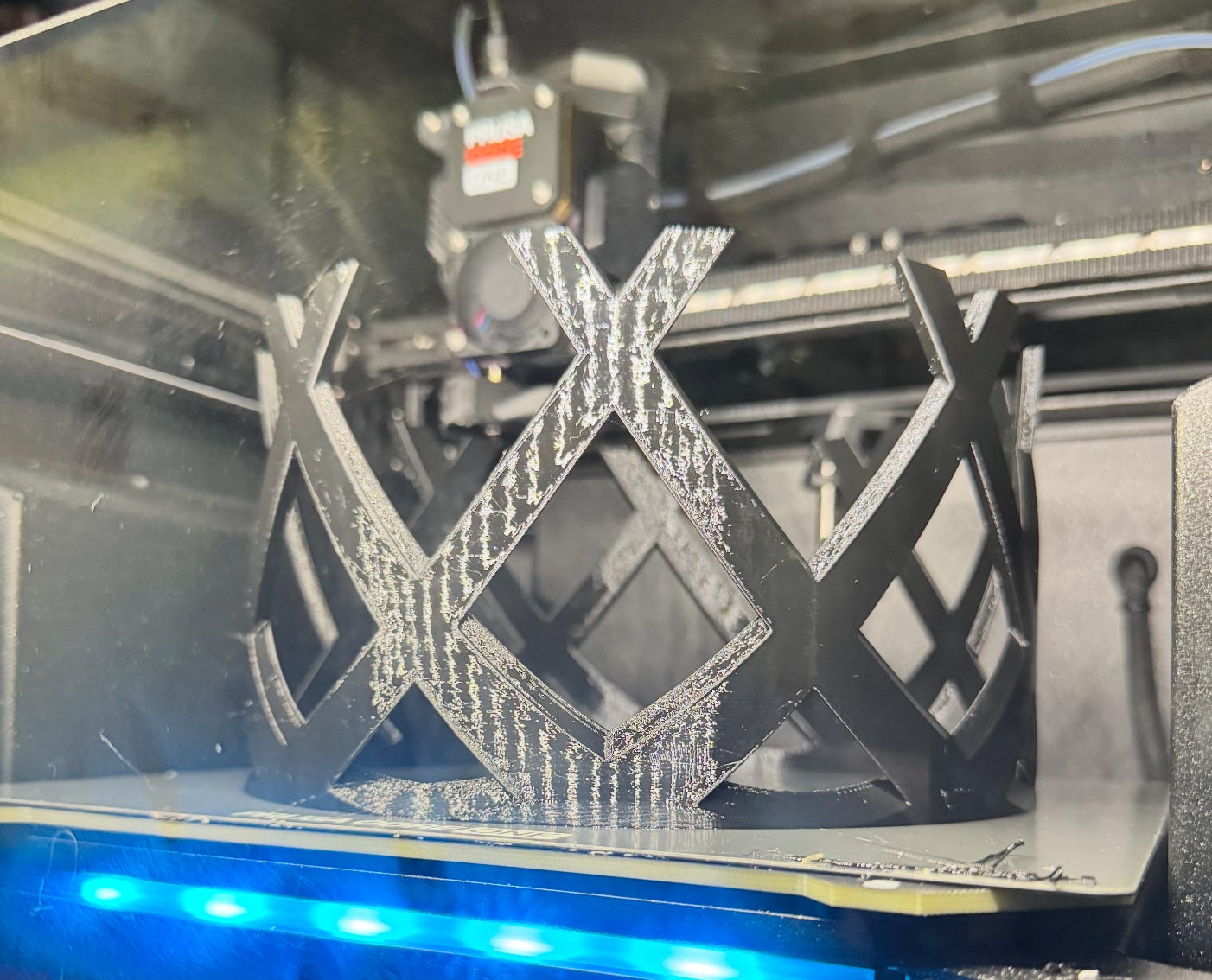
While a 3D printer isn’t always the appropriate tool, if you need something simple and plastic, there’s a very good chance this device can produce it for you. And at this point it doesn’t even have to be that small. My Prusa Core One — with its 250×220×270mm build area — isn’t even a huge printer by today’s standards, but it’s still able to print something that looks like a medium-sized basket.
Granted, the pineapple enclosures take around 10 hours (the jug is similar, hexagons less), but that’s better than waiting on Amazon, or — gasp! — driving to the store. Since there were appropriate models available to download (and possibly scale) for the first two items, I didn’t even have to model it. And yes, 3D printers can also make toys and such, which I do use it for occaisionally. Mostly for my kids.
3D printing for gardening & more!
Ultimately, we’ll see what kind of pineapple and/or pepper yields I get in the upcoming seasons. If nothing else, pineapples are infinitely cost-effective. The peppers weren’t exactly expensive either -JC
Techadjacent is where I share engineering ideas, builds, and practical tech analysis. Subscribe to get the next post in your inbox — published weekly👇
Thanks for reading! I hope you follow along on this Techadjacent journey. Fair warning: I can and do get a little off-topic in the footnotes.
Note: Some links may be affiliate
Addendum/Footnotes:
Yes, before I started labeling these as Novel Use Case, or NUC for short, I called them Questionable Use Case posts. Novel has a bit more positive connotation. Not sure how questionable growing pineapples is, but you might say that its inclusion in a techie newsletter is at least novel:
Questionable Use Case #3: Pineapple Growth in Florida + Hexagonal Preparation

Summer 2019: A simpler time before ChatGPT or even the COVID pandemic, when a pineapple could be purchased at Costco for roughly $2.50 (also roughly the price today). Even at that low price, our family Costco trips amount to once every ~2 weeks, meaning I was without fresh pineapple for a significant amount of time. So, what was I to do?
I have snapped one or two of these supports where it’s not as proportionally thick as the rest of it. I guess there are always tradeoffs.
Some part of me wants to give this design a 4, because it didn’t significantly change my life, or cure cancer, or anything like that. And it was a bit thin/lacking stakes. Is it really worthy of a PERFECT RATING? Maybe not. Nonetheless I appreciated the design, and didn’t want to hurt the person’s feelings.
If I had my way, a 3 would mean acceptable (pretty good even), 4 significantly better than average, and 5 mind-blowingly awesome. But that’s not how the world works. And I’m apparently contributing to it so as not to offend someone whose work I enjoyed, but that didn’t move me to the depths of my soul as a 5-star should.